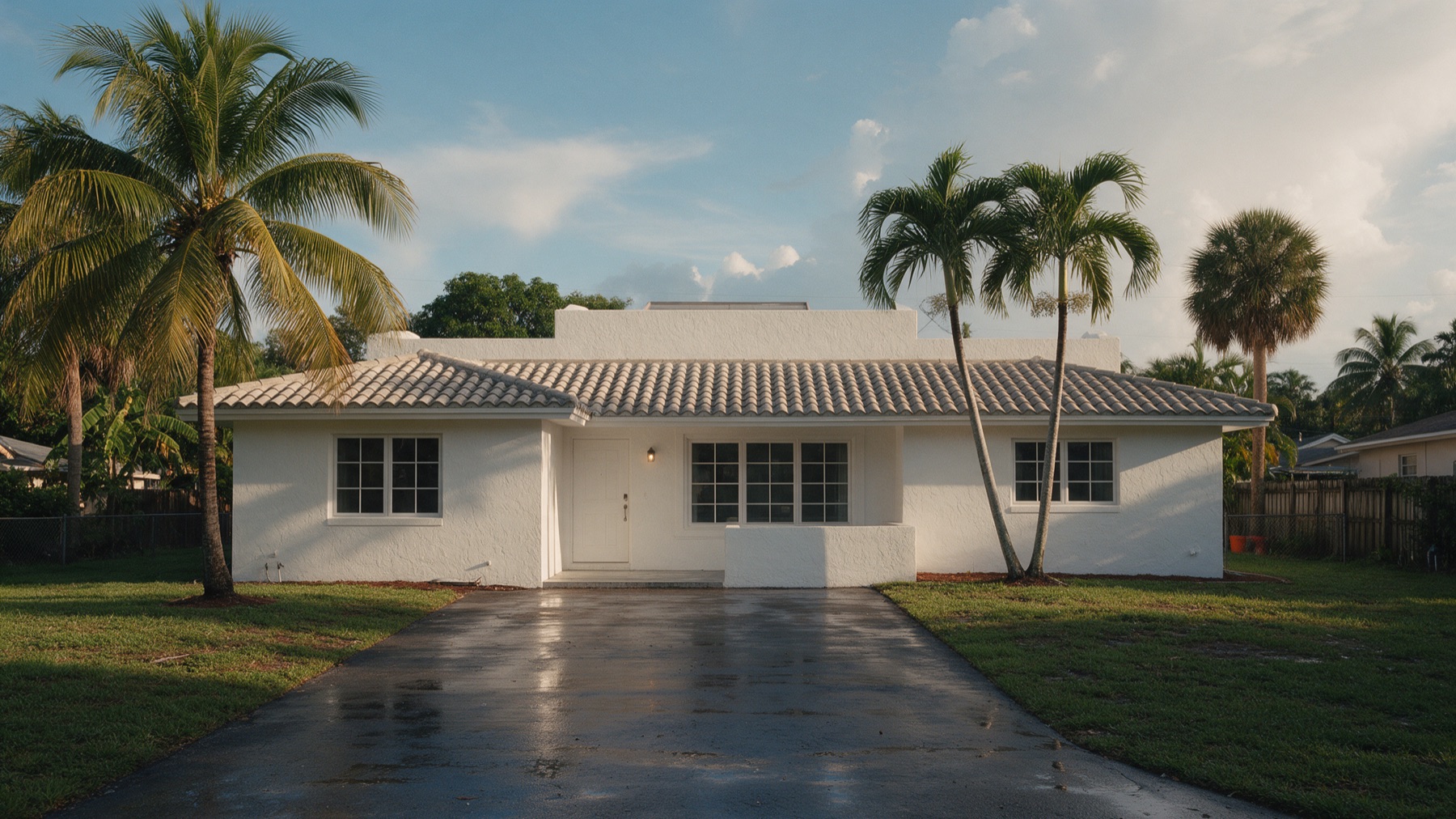
You find a brown ring on the bedroom ceiling, so you look at the roof right above it and see nothing wrong. That is normal. In many Miami homes the roof leak is not above the ceiling stain at all. Water gets in at one spot, travels, and shows up somewhere else. This guide explains how that happens and how to trace a roof leak that is not above the ceiling stain, so you can give a roofer a useful starting point.
Quick answer: Water usually enters higher than the stain and follows the roof deck, a rafter or a truss before it drips through the ceiling. Work uphill from the stain: check the attic in daylight for wet wood and trails, then look from the ground at roof features higher up the slope. Do not climb onto the roof.
What you'll need
- A bright flashlight or headlamp
- Your phone, for photos with the date on them
- Binoculars or your phone's zoom
- Painter's tape and a pencil, to mark the edge of the stain
- A bucket and towels for any active drip
- A helper, if you plan to look in the attic
Step by step
- Mark the stain. Trace its edge in pencil with the date. A stain that grows after rain is active. A ring that never changes may be old.
- Note the weather. Write down whether it appeared after a hard wind-driven rain, a slow drizzle or a dry day. Timing helps separate a roof leak from an AC or plumbing problem. Our ceiling stain guide covers that sorting.
- Check the room above and beside. Look at the walls near the stain, not just the ceiling. Water that runs down a wall points to a leak at the wall-to-roof joint.
- Go into the attic in daylight, early in the morning. Only if the hatch is easy to use and you can stand on solid joists. Wear a dust mask and watch for hot air. Never step between joists, because the ceiling will not hold you.
- Start at the wet insulation, then look up the slope. Look for dark or tea-colored wood, white powdery marks on the deck, water trails on rafters and nail points that look wet.
- Follow the trail upward. A common tracing method is to follow the staining to its highest point, since the entry is almost always higher than where the water shows. Photograph each step.
- Look for daylight. Switch off your flashlight for a moment. Small pinholes of light through the deck show where something has failed, such as a missing fastener.
- Go outside and look up the slope. Using binoculars from the yard, find what sits uphill from the stain: a pipe boot, a vent, a valley, a flat-to-tile transition, a skylight or a wall meeting the roof.
- Write it down. Note the room, the attic spot, and the roof feature that lines up. Hand that to your roofer.
How water actually travels
Roofs are layered. The tile or shingle sheds most of the rain. Under it is an underlayment, then the deck. When water gets past the first layer it does not stop. It runs down the top of the underlayment or the deck until it finds a gap, a nail, a joint or a low point. Then it may travel again along the underside of the deck or down a rafter.
One contractor column puts the gap between stain and source at 10 to 20 feet in some cases. Treat that as a rough example, not a rule. Some leaks are close to the stain and some are far.
| What the water meets | What it tends to do |
|---|---|
| Sloped deck underside | Runs down the slope toward the eave |
| Rafter or truss | Follows the wood sideways or down |
| Insulation | Soaks in and spreads, then drips at the lowest point |
| Ceiling drywall | Shows as a stain where it finally pools or seeps |
| Duct, pipe or wiring | Follows it and drips at a joint or bend |
That is why a roof leak that is not above the ceiling stain is so common. The stain marks where the water ended up, not where it entered.
Why it is trickier on Miami roofs
Tile hides the problem. On a Miami barrel or concrete tile roof, the tile is not the waterproofing. The underlayment is. Water can slip under a cracked or shifted tile, run along the underlayment and drip somewhere that has no visible damage on top. The tile itself looks fine.
Flat sections add distance. Many Miami homes have a flat roof behind a parapet or over a Florida room. Water on a low-slope roof can pond and then travel across the surface before finding a seam. The leak may be well away from where the ceiling shows it.
Sideways rain. Storms here push rain at walls and into joints. Our wind-driven rain post explains why the entry point is often a wall joint, not the roof field.
HVHZ products and sequence matter. Miami-Dade is in the High Velocity Hurricane Zone, so repairs must use approved products and follow the local process. Our HVHZ building code guide explains what that means for a repair. This is also why the repair itself is a professional job.
Why not just patch above the stain
Sealing the roof directly over the stain is a gamble. If the entry is elsewhere, the patch does nothing and the leak keeps going. Worse, caulk can trap water in the wrong place and hide the trail. A good repair finds the entry first. That is what a leak diagnosis is for. Our roof repair service page outlines how a licensed contractor approaches it, and the Miami roof cost guide shows planning ranges so a repair quote is not a surprise.
Safety first
Safety first. Stay on the ground. Do not walk on a tile roof: it cracks tile and creates a new leak. If you use a ladder only to look at the eave, put it on firm, level ground, at about a 4-to-1 angle, with a second person holding it. Keep three points of contact, and extend it at least 3 feet above the edge if you must step off it, per OSHA guidance. Never use a ladder on wet or windy days. Stay well clear of power lines and the service drop. In the attic, work early, because heat builds fast, and do not step on the ceiling drywall.
Miami roof surfaces can exceed 150°F in the afternoon, so even a quick look on the roof is a heat risk.
Stop and call a licensed roofer if…
- The stain keeps growing after the rain stops, or you see an active drip
- The ceiling is sagging, bubbling or feels soft
- You see wet or dark insulation, or wet wood in more than one spot
- The leak is near a light fixture, fan or outlet. Turn off that circuit first
- You trace the trail to a flat roof, skylight, valley or chimney you cannot see well from the ground
- The same stain returns after a repair or a dry spell
- You find mold or a musty smell
- You cannot tell where the water is coming from after one rain and one attic check
- You see cracked or missing tile, or lifted flashing from the ground
Roof repairs in Miami generally need a permit, and the permit should be pulled by the licensed contractor. Check with your building department, or see the City of Miami roofing permit page if you live inside city limits. Do not try structural work yourself.
FAQ
Can a roof leak be far from the ceiling stain?
Yes. Water can run along the deck, a rafter or a truss before it drips through the ceiling. The entry point is usually higher up the slope than the stain, and sometimes a long way from it.
How do I find where a roof leak starts if I can't see anything above the stain?
Work uphill from the stain. Check the attic in daylight for wet wood, water trails and daylight through the deck, then look from the ground at roof features higher up, such as vents, valleys and wall joints.
Should I put sealant on the roof above the stain?
No. If the entry is elsewhere the sealant does nothing, and it can hide the real trail. Find the source first, then have a licensed roofer repair it.
Does a leak only show up when it rains hard?
Often, yes. Wind-driven rain reaches joints and walls that normal rain does not. Write down the weather when a stain appears, and share it with the roofer.
Is it safe to look for the leak myself?
From the ground and the attic, with care, yes. Do not walk on the roof, especially tile. Stop if the attic is hot, the footing is unclear or the ladder is not stable.
Next step
If you have traced the trail and still cannot name the source, a trained eye will save you time. Book a free roof assessment at calendly.com/karmacgroup/30min or call 305-419-0890, and bring your photos and notes.
Sources
MIA Roofers · Roofing performed by Premier Group, Florida Certified Roofing Contractor CCC1332855. This guide is general information, not an inspection of your roof.