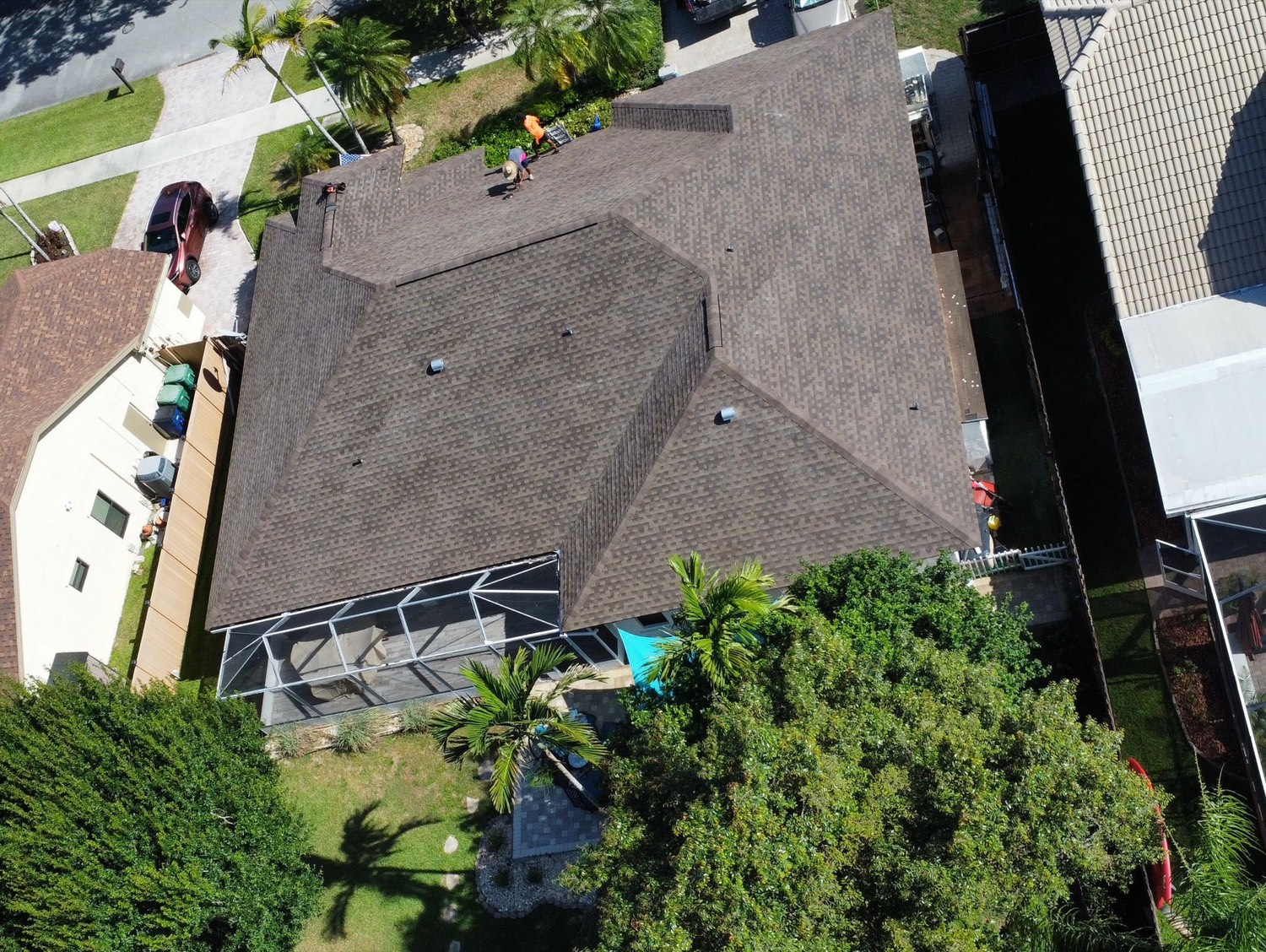
Architectural asphalt shingle is a perfectly legitimate Miami roof. It is what a large share of the county's post-war housing stock carries, it installs quickly, and it costs roughly half what tile does.
It is also asphalt, in a subtropical climate, under relentless UV. A shingle roof that would give thirty years in Maryland gives fifteen to twenty-five here, and heat is the reason. Anyone quoting you a lifespan from a national brochure is quoting the wrong number.
Asphalt shingles age by losing volatiles and shedding granules. Both accelerate with surface temperature and UV exposure, and a dark roof in Miami-Dade routinely runs well above ambient on a summer afternoon. The result is that the useful life sits at the lower end of the manufacturer range, not the upper.
Algae streaking is the other South Florida reality. Humidity and shade produce dark streaking on north-facing planes within a few years. Algae-resistant shingles genuinely help and cost very little extra — specify them.
When the structure cannot carry tile without reinforcement and you do not want to pay for the structural work. When you are selling within a few years and need a sound, warrantable, permitted roof rather than a fifty-year asset. When the neighbourhood is shingle and tile would over-improve the property. When the budget is what it is and the choice is a good shingle roof now or a bad tile roof financed badly.
All of those are reasonable, and none of them require anyone to pretend shingle is something it is not.
| System | Installed cost / sq ft | Typical service life | Notes |
|---|---|---|---|
| Architectural asphalt shingle | $7 – $12 | 15–25 yrs | The budget option in Miami-Dade. Shortest service life of anything here — UV and heat are brutal on asphalt. |
| Concrete tile (flat or profiled) | $14 – $24 | 30–50 yrs | The South Florida default. Heavy — the structure has to be able to carry it. |
| Standing-seam metal | $15 – $26 | 30–50 yrs | Gaining share fast on coastal property. Best wind performance per dollar; watch the fastener and clip spec near salt air. |
How to read these. Ranges are Miami-Dade market pricing for planning and budgeting, not a quote. Real numbers move with roof geometry and pitch, how much deck has to be replaced once the tile is off, the secondary water barrier the HVHZ requires, tear-off depth, access and staging, and how many squares of tile can be salvaged and reset versus supplied new.
These apply throughout Miami-Dade County. Permitting and local specifics are on each service area page, and the full picture is on the HVHZ code page.
The shingle, starter, hip and ridge, and fastener each need a current Miami-Dade NOA, and the NOA specifies the nailing pattern the approval depends on. A four-nail installation of a six-nail-approved shingle is not an approved installation.
The self-adhered secondary water barrier over the full deck is a Miami-Dade requirement for shingle exactly as it is for tile. It is also the single best value in the whole assembly — it is what keeps the house dry if the shingles leave in a storm.
On most reroofs the existing sheathing has to be re-fastened to the current attachment schedule before anything goes over it, and it is inspected before it can be covered.
Ridge and soffit ventilation affects both shingle life and attic moisture. In the HVHZ, ridge vents themselves need approval and have to be installed to resist wind-driven rain, which is not the same product you would use in Georgia.
The rule that decides most jobs: Miami-Dade and Broward are the only two counties in the country designated a High Velocity Hurricane Zone. The HVHZ provisions of the Florida Building Code are a stricter, separate rulebook: products need their own approval, the deck has to be sealed, attachment is tested in the field, and there are more inspections. A roofing spec that is perfectly legal in Orlando or Tampa can be non-compliant here without a single word changing on the page.
Architectural shingle generally runs $7 to $12 per square foot installed, or roughly $14,000 to $26,000 on a typical single-family home. That includes the HVHZ requirements — sealed deck, deck re-nailing and the full inspection sequence — which is why it sits above what the same roof costs in central Florida.
Realistically 15 to 25 years for a good architectural shingle. Manufacturer literature quoting 30 years or more is written for milder climates. UV and heat drive granule loss and volatile loss, and both run fast here.
Yes. Shingle assemblies are widely used in the HVHZ, provided every component carries a current Miami-Dade NOA and is installed to the nailing pattern that approval depends on — typically six nails per shingle rather than four.
If the structure is already designed for tile and you plan to hold the property, tile is usually the better long-run value. If the house is a shingle house, or the structure would need reinforcement, or you are selling within a few years, shingle is the rational choice. We will tell you what your deck and structure can carry before we talk about anything else.
Twenty minutes on site. A written report with photos and numbers. No obligation.
Pick a time on the calendar. We walk the roof, photograph what we find, and send a written report with real numbers.
Pick a time that suits you — 30 minutes, no obligation.
Active leak? Call 305-419-0890 instead; that gets triaged the same day.