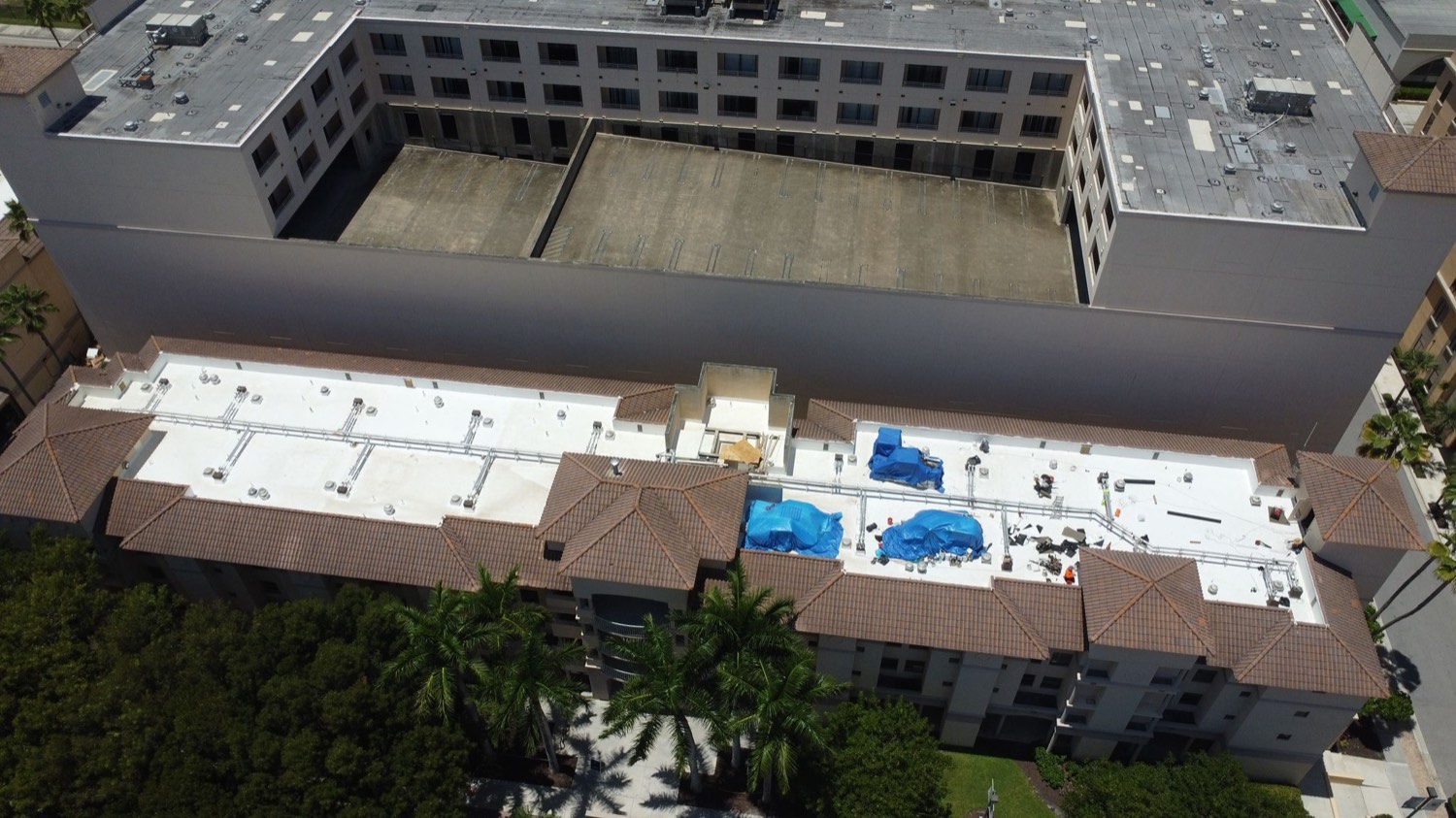
Flat roofs are not flat — they are low-slope, and they are supposed to drain. The single most common condition we find on a Miami low-slope roof is water that has nowhere to go, sitting on a membrane that was never designed to be a pond liner.
The systems that work here are well understood. Two-ply modified bitumen is the workhorse, TPO is the reflective single-ply option, and silicone coating is a genuine choice on a sound substrate. What separates a fifteen-year roof from a twenty-five-year one is the detailing at the edges and penetrations, not the field of the roof.
Standing water accelerates every failure mode a low-slope roof has: it finds seams, it grows biological load, it adds dead weight, and in Miami it breeds mosquitoes. Code expects a roof to drain, with a primary path and a secondary or overflow path sized so a blocked drain does not load the structure.
Where a roof does not drain, the fix is usually tapered insulation building a positive slope to the drains — a real added cost, typically $2 to $5 per square foot on the affected area, and the right answer anyway. Recoating over a ponding roof buys a few years and then presents the same bill.
| System | Installed cost / sq ft | Typical service life | Notes |
|---|---|---|---|
| Modified bitumen, 2-ply (low-slope) | $9 – $16 | 15–25 yrs | The standard flat-section system here — including the flat runs behind a tile parapet. |
| TPO single-ply (low-slope) | $9 – $17 | 20–30 yrs | Reflective. Common on commercial, small multifamily and larger flat residential sections. |
| Silicone restoration coating | $4 – $8 | 10–20 yrs | Only over a sound, dry substrate, and only where the existing system is not already at the layer limit. |
How to read these. Ranges are Miami-Dade market pricing for planning and budgeting, not a quote. Real numbers move with roof geometry and pitch, how much deck has to be replaced once the tile is off, the secondary water barrier the HVHZ requires, tear-off depth, access and staging, and how many squares of tile can be salvaged and reset versus supplied new.
These apply throughout Miami-Dade County. Permitting and local specifics are on each service area page, and the full picture is on the HVHZ code page.
Membrane, base sheet, fasteners and adhesive are approved as an assembly under a Miami-Dade NOA, with attachment specified by wind zone. The perimeter and corners require tighter attachment than the field.
A roof needs a primary drainage path and a secondary or overflow path sized so that a blocked primary drain does not load the structure with standing water. On older Miami buildings the overflow scuppers are frequently missing or set at the wrong height.
Where the existing roof is already at the limit of permitted coverings, or is water-soaked or deteriorated, the code requires removal to the deck. A core cut settles the question quickly and cheaply.
Perimeter edge metal is a tested, approved component that resists uplift at the most vulnerable part of the roof. It is not flashing you fabricate on site to suit.
The rule that decides most jobs: Miami-Dade and Broward are the only two counties in the country designated a High Velocity Hurricane Zone. The HVHZ provisions of the Florida Building Code are a stricter, separate rulebook: products need their own approval, the deck has to be sealed, attachment is tested in the field, and there are more inspections. A roofing spec that is perfectly legal in Orlando or Tampa can be non-compliant here without a single word changing on the page.
Two-ply modified bitumen generally runs $9 to $16 per square foot installed, and TPO $9 to $17. A silicone restoration coating over a sound substrate is $4 to $8. Tapered insulation to correct drainage adds roughly $2 to $5 per square foot on the affected area.
Modified bitumen typically gives 15 to 25 years and TPO 20 to 30, assuming the roof actually drains. A roof that ponds will fall well short of both. Coatings are a renewable 10 to 20 years and can be re-coated at the end of the term if the substrate is still sound.
Water still sitting 48 hours after rain is not normal and it is not something to live with. It signals inadequate slope, a blocked drain, or a compressed insulation layer. All three are fixable, and all three get more expensive the longer they sit.
Sometimes, and when the conditions are right it is genuinely good value. The substrate has to be sound and dry, the existing system must not be at the layer limit, and the roof needs to drain. A core cut and a moisture check will tell you in an afternoon whether you are a coating candidate or whether coating would just be an expensive delay.
Twenty minutes on site. A written report with photos and numbers. No obligation.
Pick a time on the calendar. We walk the roof, photograph what we find, and send a written report with real numbers.
Pick a time that suits you — 30 minutes, no obligation.
Active leak? Call 305-419-0890 instead; that gets triaged the same day.