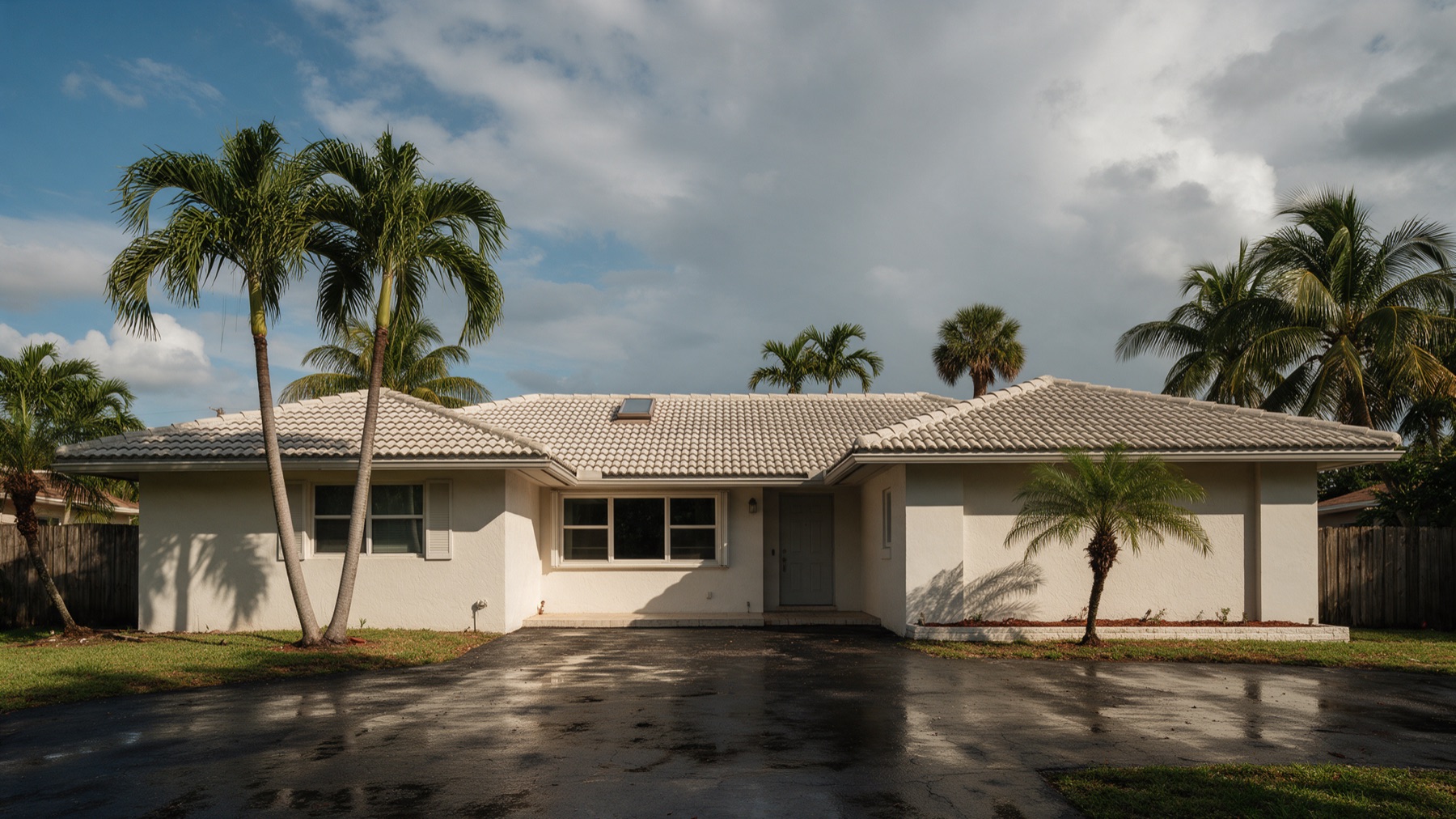
A drip under the skylight after a Miami downpour feels like an obvious roof leak. Sometimes it is. Often it is something simpler, like condensation or a clogged drain on the unit itself. This guide shows you how to sort out a skylight leak in Miami from inside the house and from the ground, so you know what to tell a roofer and what not to touch.
Quick answer: First rule out condensation: fogged glass, drips on humid dry days, or water only after showers point that way. If water appears only during rain, the cause is usually the flashing or sealant around the skylight, not the glass. Check from inside and from the ground. Do not climb onto the roof.
What you'll need
- A flashlight
- Your phone, to take dated photos
- Binoculars or your phone's zoom
- A dry towel and a bucket
- Painter's tape and a pencil, to mark any stain edge
- A helper if you look in the attic
Step by step
- Look at the glass or dome first. Beads of water or fog on the inside surface suggest condensation. Fog sealed between two panes of a glass unit points to a failed seal in the unit itself, not the roof.
- Note when it drips. Write down the date, the weather and the time. Drips on a dry, humid morning or after a hot shower point to condensation. Drips that start during or soon after rain point to a leak.
- Think about the room. A skylight over a bathroom or kitchen sees more moisture. An AC supply vent near the skylight can also cause sweating on a cold frame.
- Check the weep openings, if your unit has them. Some frames have small drain openings. Clearing visible debris from the outside is a roof job, so only look from inside. Do not poke anything into the frame.
- Look at the light shaft. The boxed shaft between the skylight and the ceiling should be dry. Dark staining on one side tells you which edge of the skylight the water is arriving from.
- Mark and photograph. Pencil the edge of any stain, date it, and recheck after the next rain.
- Check the attic in daylight, early. If there is attic access over the shaft, look for wet insulation, dark wood and trails running down from the skylight curb. Stand only on solid joists. See our attic flashlight guide.
- Look from the ground with binoculars. Check for cracked or discolored sealant at the frame, flashing that is lifted or gapped, a cracked dome or glass, and cracked or slipped tile around the skylight.
- Photograph everything and stop there. Anything you would need to touch on the roof belongs to a licensed roofer.
Condensation or leak? A quick comparison
| What you see | More likely |
|---|---|
| Fog or beads on the inside of the glass | Condensation |
| Fog trapped between the panes | Failed glass seal |
| Drips on a dry day, bathroom or kitchen below | Indoor humidity |
| Drips only during or just after rain | Leak at flashing or curb |
| Stain on one side of the shaft | Leak entering that edge |
| Stain on the ceiling a few feet from the skylight | Water traveling, see below |
Roofing contractors in Florida generally name the same suspects when rain is the trigger: the curb the skylight sits on, the flashing that ties it to the roof, and sealant that has dried out in the sun. Heat swings can also pull flashing loose over time. This is contractor guidance rather than a code rule, so treat it as a checklist, not a diagnosis.
Why skylights leak so often in Miami
Sun and heat. Sealant is the first thing to age. Strong UV and roof surface heat dry it out and open hairline gaps.
Wind-driven rain. Storms here push water sideways into joints that stay dry in ordinary rain. Our wind-driven rain guide explains why that matters.
Tile around the skylight. On a tile roof, the underlayment is the real waterproofing. A cracked tile beside the skylight can send water toward the curb, and the skylight gets the blame. If the stain is not where you expect, read why the leak is rarely above the stain.
Old units. An older skylight may have outlived its flashing, gasket or glazing. Replacing the whole unit is often the honest fix rather than another round of sealant.
What replacing a skylight involves in Miami-Dade
You will not do this yourself, but you should know what a good bid includes. Miami-Dade is in the High Velocity Hurricane Zone, so a skylight needs product-specific approval. Our HVHZ guide covers the basics. A Miami-Dade Notice of Acceptance, or NOA, for a curb-mounted skylight, for example, states the product is approved as described and designed to comply with the HVHZ requirements of the Florida Building Code. It also lists a missile impact rating and an expiration date.
Two practical points follow. First, ask your roofer for the NOA number for the exact model and check that it is current. Second, a skylight approved only under the general state system is not the same as one approved for the HVHZ, so do not accept a unit just because it has a statewide approval. Whether your job needs a permit, and what it needs to be submitted, is for your building department and your licensed contractor. Check with them.
For a sense of what repair versus replacement may cost, see the Miami roof cost guide. Our roof repair page explains how a licensed contractor approaches a diagnosis.
Safety first
Safety first. Stay off the roof. Walking on tile cracks it and creates a new leak, and Miami roof surfaces can pass 150°F, so heat exhaustion is a real risk. If you use a ladder only to look at the eave, set it on firm, level ground at about a 4-to-1 angle, with a second person holding it. Keep three points of contact, and extend it 3 feet above the edge if you must step off it, per OSHA guidance. Never use a ladder on wet or windy days. Stay well clear of power lines and the service drop. Never go up while the roof is wet, even with dew, or when lightning is nearby. Do not caulk a skylight yourself: sealing it wrong can trap water and hide the real entry.
Stop and call a licensed roofer if…
- Water drips during or after rain and the glass is dry
- The light shaft or ceiling around it is stained, sagging, bubbling or soft
- You see wet insulation or dark wood near the curb in the attic
- Sealant is cracked, missing or peeling, or flashing is lifted or gapped
- The dome or glass is cracked, or the frame looks bent
- Tile around the skylight is cracked or has slipped
- The leak is near a light, fan or outlet. Turn that circuit off first
- The same stain returns after a dry spell or after someone patched it
- You smell mustiness or see mold on the shaft
- You are not sure whether it is condensation or a leak after one rain and one dry day
Roof repairs and replacements in Miami-Dade generally require a permit, and the permit should be pulled by the licensed contractor. Check with your building department. Florida has an owner-builder exemption, but in the HVHZ it still requires permits and inspections and makes you legally responsible, so it is not a shortcut.
FAQ
Is my skylight leaking or is it condensation?
Look at the timing and the glass. Fog or beads on the inside, or drips on dry humid days, point to condensation. Water only during or after rain, with dry glass, points to a leak at the flashing or curb.
Why does my skylight leak only in heavy rain?
Heavy, wind-driven rain reaches gaps that light rain does not. Dried sealant, lifted flashing or a hairline crack at the curb may stay dry until a storm pushes water into it.
Can I seal a leaking skylight myself?
We do not recommend it. It means working on the roof, which is dangerous, and sealing the wrong spot can hide the entry and let water keep spreading. A roofer should find the source first.
Does a skylight replacement need a Miami-Dade approved product?
In the High Velocity Hurricane Zone, products must carry the right approval for that zone. Ask your licensed roofer for the NOA and confirm it is current.
How long does a skylight last in South Florida?
There is no single number. Sun, heat and storms age sealants and flashing, and each unit differs. Have the skylight checked whenever you have your roof inspected.
Next step
If you have your photos and notes and still cannot tell what is wrong, a short visit will save you guessing. Book a free roof assessment at calendly.com/karmacgroup/30min or call 305-419-0890.
Sources
- floridabuilding.org/upload/PR_Tech_Docs/FL15146_R5_AE_(d)%20Eval%2015146.6.pdf
- www.miamidade.gov/building/library/productcontrol/noa/26080504.pdf
- www.osha.gov/laws-regs/regulations/standardnumber/1926/1926.1053
- www.osha.gov/Publications/portable_ladder_qc.html
- www.leoroofingfl.com/residential-roofing/skylight-repair/
MIA Roofers · Roofing performed by Premier Group, Florida Certified Roofing Contractor CCC1332855. This guide is general information, not an inspection of your roof.