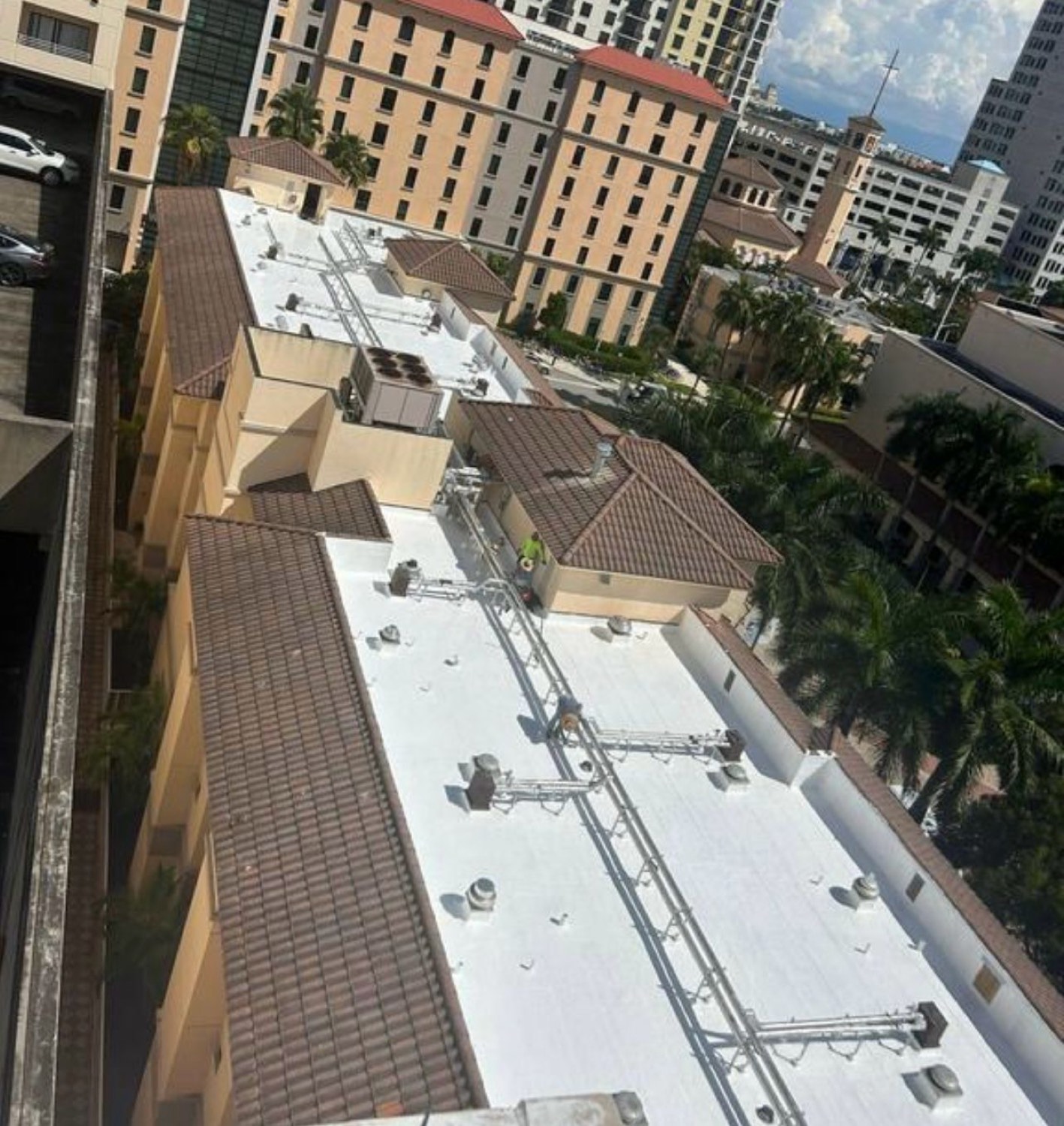
Replacing a roof in Miami-Dade is not the same job as replacing one in Orlando, and the price difference is not markup. It is the High Velocity Hurricane Zone: every product needs its own county approval, the entire deck has to be sealed with a secondary water barrier, the deck attachment gets re-nailed to current code, and the county inspects five times instead of two.
That is worth understanding before you compare bids, because the cheapest number in the stack is very often the one that left the code requirements out. We would rather walk you through what has to happen and let you judge the bids yourself.
Two roofs of identical square footage on the same street can differ by twenty thousand dollars, and almost none of that is the brand of tile. It is these five things, roughly in order of impact.
Florida limits how many roof coverings a structure may carry. Where an existing roof is already at the limit, or where the covering is water-soaked or deteriorated enough that it is no longer a sound base, the code requires removal down to the deck.
In practice, in Miami-Dade, a full tear-off is the normal and usually the right answer on any roof past about twenty years. The sealed-deck requirement is applied to the deck itself — which means you cannot satisfy it without getting to the deck. A bid proposing to leave the old system in place deserves a direct question about how the secondary water barrier is being achieved.
A straightforward single-family shingle roof is typically two to four days of production once material lands. Tile runs one to three weeks depending on size and whether tile is being salvaged and reset. A flat section behind a parapet adds a day or two.
The schedule variable nobody controls is inspection availability. Miami-Dade and each municipality set their own scheduling queue, and the roof sits open — dried in, but open — until the inspector arrives. We plan around it rather than discovering it, and the roof is watertight every night regardless.
| System | Installed cost / sq ft | Typical service life | Notes |
|---|---|---|---|
| Architectural asphalt shingle | $7 – $12 | 15–25 yrs | The budget option in Miami-Dade. Shortest service life of anything here — UV and heat are brutal on asphalt. |
| Concrete tile (flat or profiled) | $14 – $24 | 30–50 yrs | The South Florida default. Heavy — the structure has to be able to carry it. |
| Clay barrel tile | $18 – $30 | 40–75 yrs | Coral Gables, Coconut Grove and most of the historic stock. Highest material cost, longest life. |
| Standing-seam metal | $15 – $26 | 30–50 yrs | Gaining share fast on coastal property. Best wind performance per dollar; watch the fastener and clip spec near salt air. |
| Modified bitumen, 2-ply (low-slope) | $9 – $16 | 15–25 yrs | The standard flat-section system here — including the flat runs behind a tile parapet. |
| TPO single-ply (low-slope) | $9 – $17 | 20–30 yrs | Reflective. Common on commercial, small multifamily and larger flat residential sections. |
How to read these. Ranges are Miami-Dade market pricing for planning and budgeting, not a quote. Real numbers move with roof geometry and pitch, how much deck has to be replaced once the tile is off, the secondary water barrier the HVHZ requires, tear-off depth, access and staging, and how many squares of tile can be salvaged and reset versus supplied new.
These apply throughout Miami-Dade County. Permitting and local specifics are on each service area page, and the full picture is on the HVHZ code page.
Miami-Dade sits inside the High Velocity Hurricane Zone. The HVHZ chapters of the Florida Building Code are a stricter, separate set of requirements covering product approval, deck attachment, the secondary water barrier and field testing of the installed assembly.
A Notice of Acceptance approves a specific product in a specific assembly, and specifies how it may be installed. NOAs expire and must be renewed by the manufacturer. They are public — you can look up any of them on the County product approval search before you sign.
The HVHZ requires a continuous secondary water barrier over the deck, so the building stays dry even if the covering is lost in a storm. The permit holder signs an Affidavit of Compliance for deck attachment and the secondary water barrier and gives it to the inspector at the first inspection.
Work permitted today runs under the 8th Edition (2023) of the Florida Building Code. The 9th Edition takes effect 31 December 2026, tightening underlayment and fastening on full replacements while relaxing the recover-versus-replace rule. Which side of that date your permit lands on is worth a conversation if you are planning around the end of the year.
The rule that decides most jobs: Miami-Dade and Broward are the only two counties in the country designated a High Velocity Hurricane Zone. The HVHZ provisions of the Florida Building Code are a stricter, separate rulebook: products need their own approval, the deck has to be sealed, attachment is tested in the field, and there are more inspections. A roofing spec that is perfectly legal in Orlando or Tampa can be non-compliant here without a single word changing on the page.
For a typical single-family home, architectural shingle generally runs $14,000 to $26,000, concrete tile $28,000 to $50,000, and clay barrel tile $35,000 to $70,000 or more. Per square foot installed that is roughly $7 to $12 for shingle, $14 to $24 for concrete tile, and $18 to $30 for clay. Miami-Dade sits above the Florida average because of the HVHZ code requirements, not because of local markup.
Yes. Roof replacement requires a permit everywhere in Miami-Dade County, and it should be pulled in the contractor's name. The permit brings the inspection sequence with it, which is what actually protects you — an unpermitted roof is both a code violation and a problem when you sell or file a claim.
Shingle is typically two to four days of production. Tile runs one to three weeks depending on size and whether existing tile is being salvaged. The larger schedule variable is inspection scheduling, which is set by the county or your municipality, not by us. Your roof is dried in and watertight every night regardless of where it sits in the sequence.
Often yes, and Senate Bill 4-D is the reason. Since May 2022, if your existing roof was built to the 2007 Florida Building Code or later, crossing the 25 percent damage threshold no longer forces a full replacement — only the repaired portion has to meet current code. The permit record usually settles it, and we pull it as part of the assessment.
It depends on the structure and how long you plan to hold the property. Concrete tile is the regional default and the structure is usually already designed for the weight. Standing-seam metal has the best wind performance per dollar and is gaining share fast on coastal property. Shingle is the lowest first cost but the shortest life here — UV and heat are hard on asphalt. We will tell you which of these your roof deck can actually carry before we talk about looks.
Twenty minutes on site. A written report with photos and numbers. No obligation.
Pick a time on the calendar. We walk the roof, photograph what we find, and send a written report with real numbers.
Pick a time that suits you — 30 minutes, no obligation.
Active leak? Call 305-419-0890 instead; that gets triaged the same day.