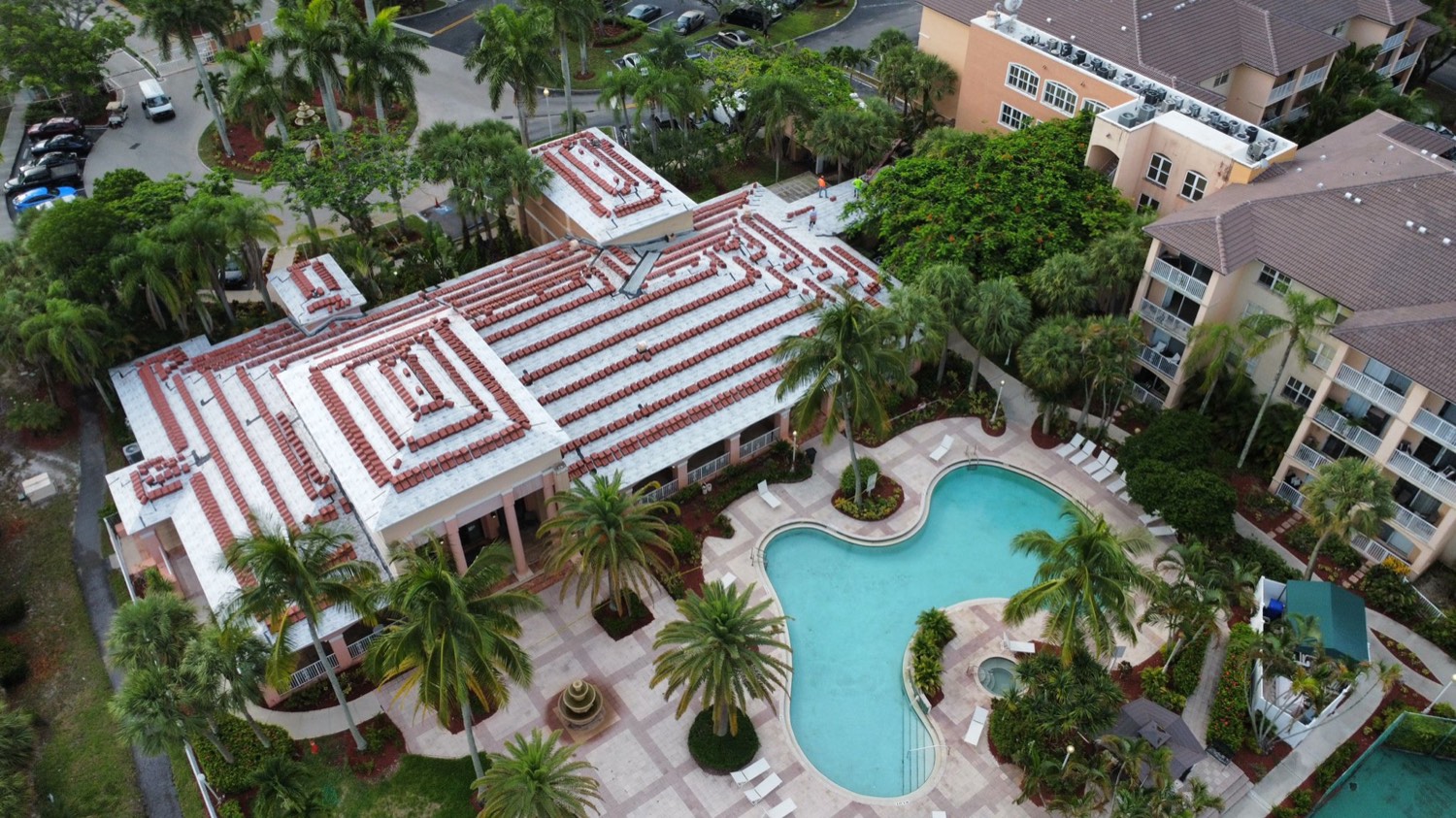
Tile Roof Replacement in Miami — Concrete & Clay Barrel
Tile is the South Florida default, and it is the system where the difference between a good installer and a bad one is least visible from the ground and most expensive to discover.
Tile is the South Florida default, and it is the system where the difference between a good installer and a bad one is least visible from the ground and most expensive to discover.
Concrete and clay tile do not keep water out on their own. The underlayment does. Tile is a wind-resistant, UV-resistant shield that protects the waterproofing beneath it — which means a tile roof is really two systems, and the one you cannot see is the one that fails.
That is why a tile reroof in Miami-Dade is priced the way it is, and why "we will just replace the broken tiles" is usually the wrong answer on a roof past twenty years. The tile may have decades left. The underlayment does not.
Concrete tile is the volume product in South Florida: lower cost, enormous profile and colour range, 30 to 50 year service life. It is heavier than clay in most profiles and the colour is a surface treatment that softens over decades.
Clay barrel tile is the traditional Mediterranean roof of Coral Gables, Coconut Grove and the historic stock. The colour is fired through the body, so it does not fade — a 60-year-old clay roof looks like a clay roof. It costs meaningfully more and lasts meaningfully longer.
There are three attachment methods in general use: mechanically fastened (screws or nails), mortar-set, and adhesive-set (a polyurethane foam adhesive). Each has its own NOA, and each NOA specifies exactly how it may be applied — how much adhesive, where, at what coverage.
On mortar-set and adhesive-set systems, Miami-Dade does not take the contractor's word for it. The HVHZ code requires a field uplift test to TAS 106 after installation and before the final inspection: tiles are physically pulled to confirm they resist the required uplift load. It is one of the very few places in American construction where an inspector verifies the installed result rather than the paperwork.
Ask a bidder how many uplift pulls they have budgeted. The answer tells you quickly whether they have done this work in Miami-Dade before.
On a roof where the tile is sound but the underlayment is finished, salvaging the tile and resetting it over a new waterproofing assembly is often the right call. It is cheaper than new tile, and it is frequently the only way to keep the roof looking like itself.
It also solves a real problem: profiles get discontinued. If a third of your roof needs tile and the profile has not been made in fifteen years, matching it means salvage — from your own roof, from a reclaim yard, or from the least visible elevation, with new tile used where nobody sees it.
Expect to lose 15 to 25 percent of the tile to breakage during removal and handling. A bid that assumes zero breakage has not done this before.
A very large share of South Florida tile homes have a low-slope section — over a porch, a Florida room, a carport, or a flat run hidden behind a parapet. It is a different system with a different service life, and it is where most tile-roof leaks actually originate.
It should be scoped, priced and replaced as its own line item. If a tile bid does not mention the flat section, either the bidder did not walk the roof or they are planning to leave it. Both are worth knowing.
| System | Installed cost / sq ft | Typical service life | Notes |
|---|---|---|---|
| Concrete tile (flat or profiled) | $14 – $24 | 30–50 yrs | The South Florida default. Heavy — the structure has to be able to carry it. |
| Clay barrel tile | $18 – $30 | 40–75 yrs | Coral Gables, Coconut Grove and most of the historic stock. Highest material cost, longest life. |
| Modified bitumen, 2-ply (low-slope) | $9 – $16 | 15–25 yrs | The standard flat-section system here — including the flat runs behind a tile parapet. |
How to read these. Ranges are Miami-Dade market pricing for planning and budgeting, not a quote. Real numbers move with roof geometry and pitch, how much deck has to be replaced once the tile is off, the secondary water barrier the HVHZ requires, tear-off depth, access and staging, and how many squares of tile can be salvaged and reset versus supplied new.
These apply throughout Miami-Dade County. Permitting and local specifics are on each service area page, and the full picture is on the HVHZ code page.
A tile assembly is approved as an assembly. The tile NOA, the fastener or adhesive NOA and the underlayment NOA all have to be current and compatible. Mixing an approved tile with an unapproved adhesive is a failed inspection.
A static field uplift test is required after installation and before the final inspection, confirming the installed tile resists the minimum required uplift load. This is a physical test on your roof, not a certification on paper.
The secondary water barrier goes onto the deck before any tile work begins, and it is inspected on its own. It is the reason a tile reroof cannot be done as an overlay.
Tile is heavy. Changing from shingle to tile, or from a light profile to a heavy one, can require structural review before the permit issues. That is a real cost and a real timeline item, and it belongs in the conversation before anyone picks a colour.
The rule that decides most jobs: Miami-Dade and Broward are the only two counties in the country designated a High Velocity Hurricane Zone. The HVHZ provisions of the Florida Building Code are a stricter, separate rulebook: products need their own approval, the deck has to be sealed, attachment is tested in the field, and there are more inspections. A roofing spec that is perfectly legal in Orlando or Tampa can be non-compliant here without a single word changing on the page.
Concrete tile generally runs $14 to $24 per square foot installed, and clay barrel tile $18 to $30. For a typical single-family home that is roughly $28,000 to $50,000 for concrete and $35,000 to $70,000 or more for clay. Salvaging and resetting existing tile over new underlayment costs less — about $4 to $8 per square foot on top of the underlayment work.
The tile itself lasts 30 to 50 years for concrete and 40 to 75 for clay. The underlayment beneath it does not — typically 20 to 30 years for a modern self-adhered system, and less for older felt assemblies. That mismatch is why tile roofs are commonly reroofed with the original tile salvaged and reset.
If the underlayment is sound and the breakage is isolated, yes — and it is the right repair. If the roof is past twenty years, replacing tiles is treating the symptom. We will tell you which situation you are in, and the honest answer is sometimes that you have five more years and should spend the money later.
TAS 106 is a field uplift test required by the HVHZ code on mortar-set and adhesive-set tile systems. Tiles are physically pulled after installation, before the final inspection, to confirm they resist the required uplift load. If your tile is being set in mortar or adhesive in Miami-Dade, yes, it is required — and a contractor who does not budget for it is planning to skip it.
Salvage. Existing tile is removed carefully, the underlayment is replaced, and the original tile goes back on. Where breakage leaves you short, new tile of a similar profile goes on the least visible elevation and the salvaged tile covers the street-facing planes. Reclaim yards are also worth checking for older clay profiles.
Twenty minutes on site. A written report with photos and numbers. No obligation.
Pick a time on the calendar. We walk the roof, photograph what we find, and send a written report with real numbers.
Pick a time that suits you — 30 minutes, no obligation.
Active leak? Call 305-419-0890 instead; that gets triaged the same day.