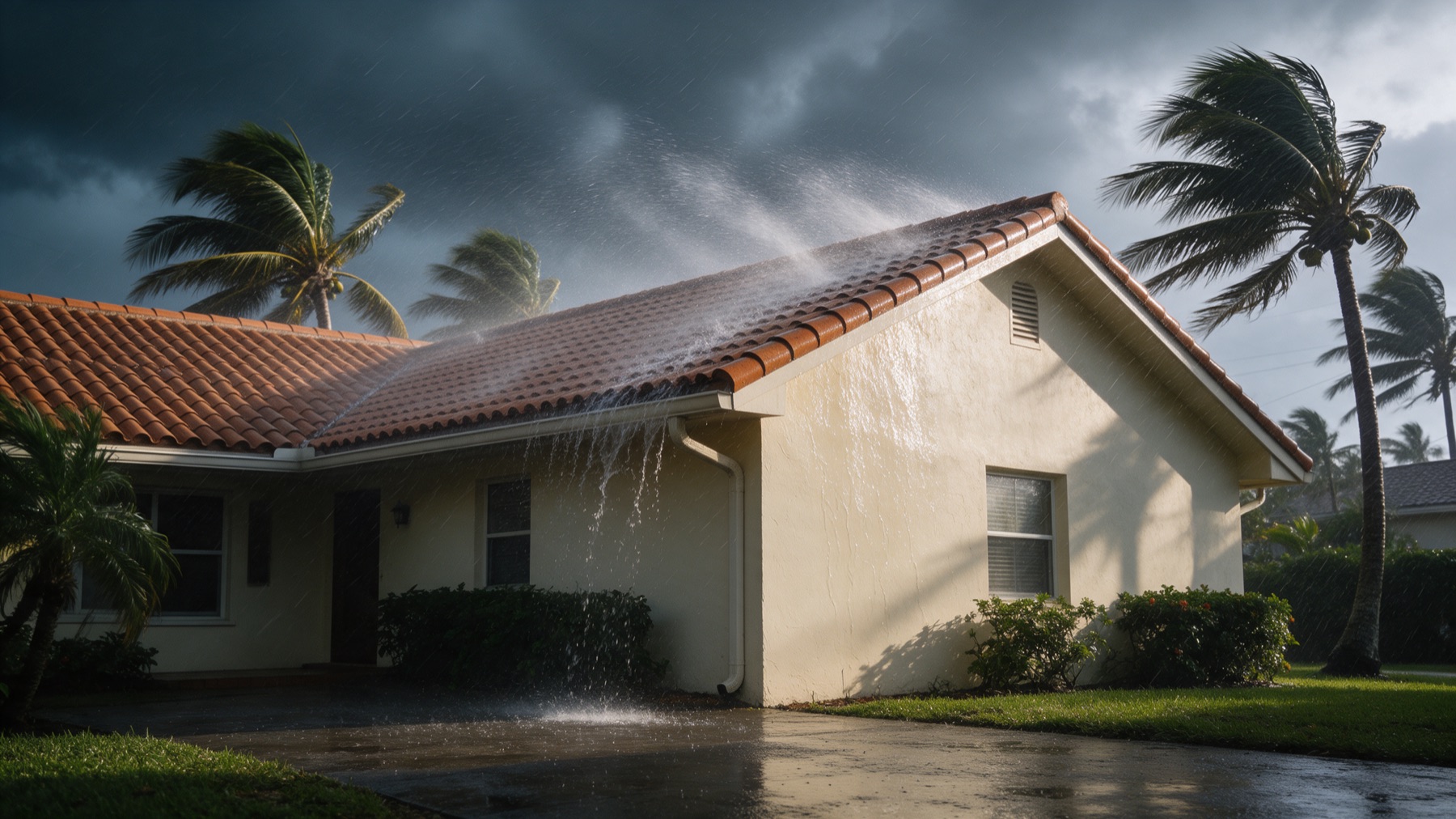
Your roof stays dry through a week of afternoon downpours, then one squall off the bay and there is a wet patch on the ceiling. That is the signature of a wind-driven rain roof leak in Miami. The roof did not suddenly fail; the water arrived from a direction it was never built to shed. Here is how rain gets in sideways and where to look from the ground before you call anyone.
Quick answer: A roof sheds water that falls down. Wind pushes water up under tile and shingle laps, through gable and soffit vents, and into the joint where a wall meets a lower roof. If your roof leaks only when it is windy, start on the side of the house that faced the wind and look at vents, wall-to-roof flashing, the eave edge and the parapet on any flat section, not the spot directly above the stain.
What you'll need
- Your phone, for photos and notes
- Binoculars or a phone zoom
- A flashlight, if you have safe attic access from inside
- Nothing else. This is a ground-level and attic-hatch job. You do not go on the roof.
Step by step
- Write down the weather when it leaked. Date, time, and which way the wind was blowing, from your weather app's radar. Wind-driven leaks repeat under the same conditions.
- Confirm it is a wind leak. Dry after calm heavy rain and wet after a windy squall means wind-driven. If it drips in every rain, it is a plain leak, and our post-hurricane roof check covers that from the ground.
- Find the windward side. That is where the water went in, even if the stain is in a room across the hall.
- Scan the windward eave and gable with binoculars. Look for a gable vent, a soffit panel that has dropped or gone missing, a lifted drip edge, or a gap behind the fascia.
- Scan the roof plane. On tile, look for a slipped, cracked or missing tile and any ridge cap that has moved. On shingle, lifted or creased tabs on the windward slope. On metal, a panel edge standing up or a missing closure at the eave.
- Look at every place a wall meets a roof. A second-story wall above a lower roof, a Florida room tied into the house, a chimney. Look for cracked stucco or a dark streak on the wall just above the roof.
- Check the flat section behind the parapet. From the ground or a window, look at the parapet cap and the stucco under the scuppers. Stains under a scupper or an open cap seam are where sideways rain gets behind the membrane.
- Look from the attic hatch with a flashlight. Stay on the hatch ladder. Look toward the windward side for wet insulation, dark streaks on the deck underside, rust lines from nails, and daylight through a vent or soffit. Do not crawl across joists to chase it.
- Photograph everything, outside and in. Wide shots first, then zoom. Dated photos matter if this becomes an insurance conversation; our pre-storm photo guide has the routine.
Why Miami roofs leak sideways
A sloped roof works because gravity pulls water down over overlapping pieces. Wind breaks that assumption. A gust against the slope pushes water uphill under the laps and, on tile, through the gaps around every piece. Tile was never the waterproof layer; the underlayment under it is. If that underlayment is old, cracked at the laps or torn at a fastener, the water ends up on the deck and then on your ceiling.
The second route is the openings the roof needs to breathe. Gable, soffit and off-ridge vents are designed to pass air, and in a squall they pass water too. FEMA's retrofit guide for existing houses lists improving the water intrusion resistance of attic vents among its basic measures and strengthening soffits among its intermediate ones.
The third route is any wall above a roof. Rain gets blown against it in sheets, and all of it lands at the flashing where wall meets roof. The fourth is the flat roof behind the parapet, where wind lifts the membrane edge and drives rain over the cap and down behind the stucco. If a blocked scupper already has the roof holding water, the wind only has to move it an inch higher than the flashing.
How the code deals with it in the HVHZ
Miami-Dade and Broward are the High Velocity Hurricane Zone, and the Florida Building Code treats wind-driven rain here as a test, not a theory. Roof tile systems are evaluated under Section 1523.6.5.2 of the Building code, which includes a wind-driven rain test called TAS 100 alongside the static uplift tests. TAS 100 sprays water on a full test deck, built with eaves, a valley and a rake edge, at 8.8 inches per hour while a wind generator runs at 35, 70, 90 and 110 mph in stages. The pass criterion is simple: no water through the deck sheathing. Our HVHZ building code guide explains the approval system behind this.
The code also sets what goes under the covering. Under Section 1518.2 of the 2023 code, HVHZ underlayment for shingle, metal and similar coverings is a self-adhering membrane over the entire deck, a taped-joint system with every deck seam sealed, or two layers of nailable underlayment. Tile underlayment has its own testing under Section 1523.6.5.2.1. Any of these beats the single layer of felt under many roofs built decades ago.
The 9th Edition (2026) code goes further for tile: the Florida Building Commission's analysis of the new HVHZ test protocols says all tile underlayment systems must be tested and carry a product approval. Miami-Dade's permitting notice puts the effective date at December 31, 2026. If you are planning a re-roof, our 2026 code guide covers the timing.
Where wind-driven water gets in, by roof type
| Roof type | Most likely entry in a squall | What you can see from the ground |
|---|---|---|
| Clay or concrete tile | Under the tile laps onto worn underlayment; around slipped or cracked tiles; at mortar ridge caps | Slipped or missing tiles, cracked caps, debris lines under the eave course |
| Asphalt shingle | Under lifted tabs on the windward slope; at the eave where the drip edge has lifted | Shingle edges standing up, creased tabs, a wavy drip edge |
| Metal panel | At eave and rake closures; around aged fastener washers | A panel edge standing proud, missing foam closures, rust streaks |
| Flat (modified bitumen or single-ply) | Over or behind the parapet cap; at scuppers; at wall-to-roof flashing | Stains under scuppers, open cap seams, bubbling stucco on the parapet |
Safety first
Everything in this guide is done from the ground, a window or the attic hatch. Never walk on a tile roof: tile cracks under foot and creates the leak you were hunting. Never go up during or right after a storm, or when the roof is wet. If you use a ladder to look at a vent or soffit from the eave, set it on firm, level, dry ground at a 4-to-1 angle, extend it 3 feet above the edge, keep three points of contact, have a second person hold it, and never use it on a wet or windy day. Stay clear of the service drop and any power line near the roof edge. Miami attics are dangerously hot by midday, so work early and get out if you feel dizzy.
Stop and call a licensed roofer if…
- The leak appears in every windy storm, not just a direct hit, and is getting worse
- Binoculars show a slipped, cracked or missing tile, a moved ridge cap, or a shingle tab folded back
- A soffit panel is missing or hanging, or you can see daylight through a gable vent from inside
- Stucco above a lower roof is cracked or stained in a line at flashing height
- The flat section behind the parapet holds water, or the cap seam has opened
- Attic insulation is wet over an area wider than a dinner plate, or the deck underside is dark and soft
- There is a ceiling bulge. Water is pooling above it. Keep people out from under it.
- You cannot find any entry point from the ground. A wind leak can start 15 feet from the stain.
A proper fix is usually flashing, vent or underlayment work, not a tube of sealant on the tile. Our roof repair service covers that, and a roof inspection will tell you whether an older tile roof's underlayment is past the point where repairs make sense. For planning ranges, see the Miami roof cost guide.
FAQ
Why does my roof only leak when it is windy?
Because the water is being pushed somewhere gravity never takes it: up under laps, through vents, or against a wall and down behind the flashing. In calm rain those paths stay dry.
Can a tile roof leak without any broken tiles?
Yes. Tile is not the waterproof layer; the underlayment beneath it is. Wind drives water through the gaps around every tile onto the underlayment, and if that layer is old or torn at the laps, the roof leaks with every tile in place.
Will sealing my gable vents stop the leak?
It might stop that path and create a ventilation problem. Vents exist to move air through the attic. In the HVHZ the better answer is a vent product with wind-driven rain resistance, installed by a licensed contractor under its product approval, not a sheet of plastic from inside.
Find the entry point before the next squall
If you have a ceiling stain that only shows up on windy days, book a free roof assessment or call 305-419-0890. We will trace where the water is getting in and tell you whether it is a flashing fix, a vent fix, or a sign the underlayment is done.
Sources
- www.intertek.com/building/standards/tas-100/
- www.floridabuilding.org/upload/PR_Tech_Docs/FL17326_R5_AE_ERP14001.5%202023%20Ev
- www.miamidade.gov/building/library/2023-fbc-roofing-code-changes.pdf
- www.floridabuilding.org/fbc/thecode/2026_Code_Development/Analysis_Code_Changes/
- www.miamidade.gov/resources/economy/building/documents/fbc-ninth-code-change.pdf
- www.fema.gov/sites/default/files/documents/fema_p-804-technical-advisory_072023.
MIA Roofers · Roofing performed by Premier Group, Florida Certified Roofing Contractor CCC1332855. This guide is general information, not an inspection of your roof.