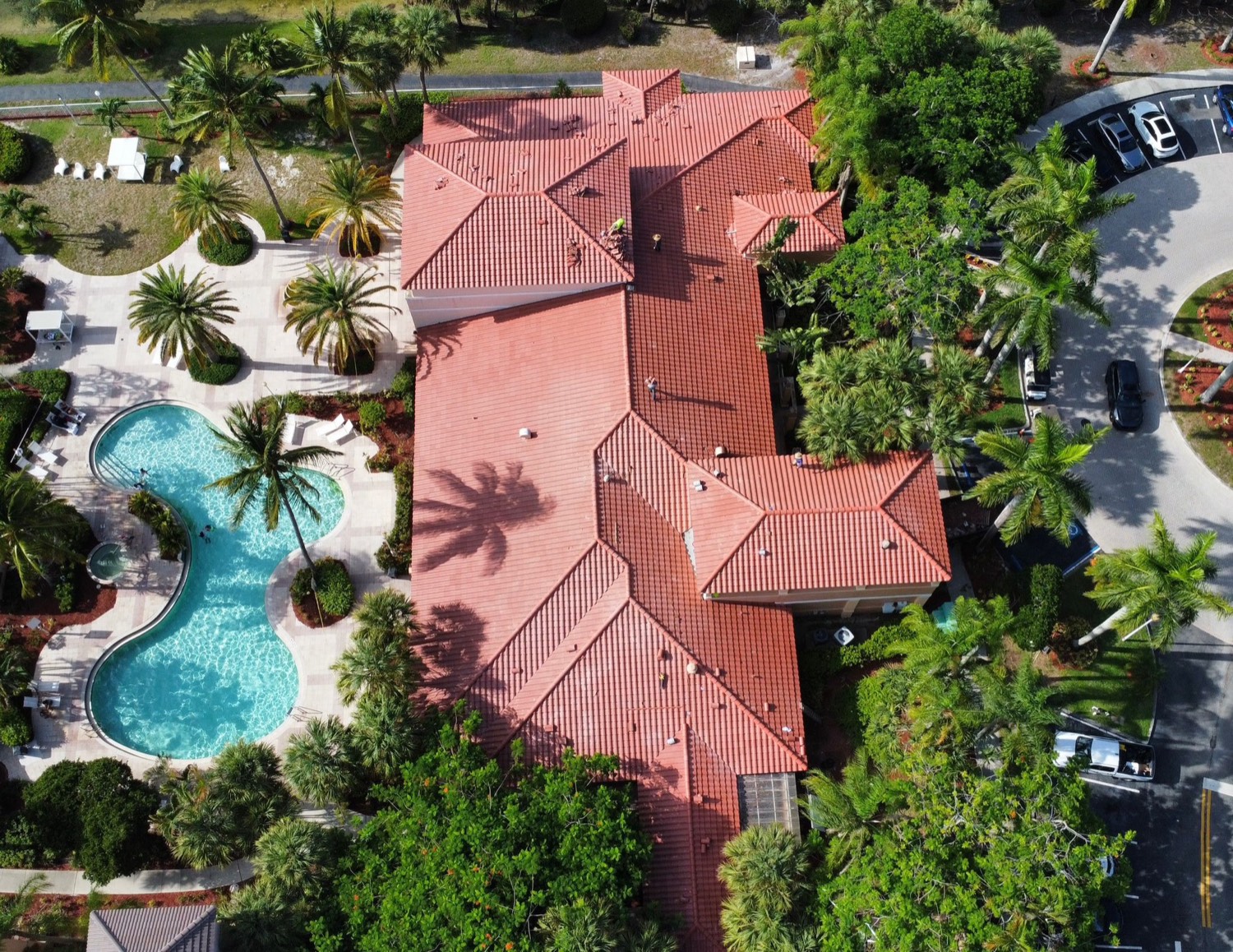
Miami-Dade is the most hurricane-exposed metropolitan county in the United States, and the entire HVHZ code exists because of it. When a storm does damage a roof here, the sequence that protects you is: make it safe, cover it, document it, then decide what it needs — in that order, and not in any other.
The pressure to skip straight to signing something comes from the people who arrive in the neighbourhood the week after. That is worth being ready for before it happens.
Wind damage to a roof is often not dramatic. Whole sections leaving the building is the obvious case, but the more common and more consequential damage is subtle: tiles lifted and reseated at the wrong angle, shingles creased at the nail line where they folded back and laid down again, ridge and hip caps displaced, edge metal peeled and re-set by the next gust.
Creased shingles are the classic example. They look fine from the street and they have lost their seal — they will leak in the next storm and they are legitimate storm damage. An adjuster who has not been on the roof will not see them.
This is the question that decides whether a carrier is buying a repair or a roof. If more than a quarter of the roof is damaged, the old rule forced the entire system up to current code. Senate Bill 4-D changed that in May 2022: where the existing roof was built or repaired to the 2007 Florida Building Code or later, only the damaged portion has to be brought to current code.
The practical dividing line is the permit date. A roof permitted on or after 1 March 2009 was built under the 2007 code or later and will generally qualify. An older roof crossing the threshold usually still requires full replacement. The permit record is public, and pulling it is a far better use of everyone's time than arguing about it.
After every significant storm, out-of-state crews arrive, knock doors, and offer to handle everything. Some are legitimate. Many are unlicensed in Florida, will not be here when a warranty claim arrives, and are working under a contract that assigns your claim rights to them.
The protections are simple and they cost nothing: verify the licence at myfloridalicense.com, confirm the permit will be pulled in the contractor's name, refuse to sign anything at the door, and never pay a large deposit. Florida law limits what a residential roofer may collect up front before work begins.
| Item | Typical range | Notes |
|---|---|---|
| Roof repair (single-source leak) | $650 – $4,500 | Most isolated leaks land in the high three to low four figures. A chronic leak needs a survey, not a patch. |
| Roof inspection / condition report | Free – $600 | Ours is free. A wind mitigation inspection for your insurer is a separate, licensed report and usually $75–$175. |
| Plywood / deck replacement | $70 – $130 per sheet | Nobody can see the deck until the roof is off. Get this as a stated unit price in the contract, not a change order. |
| Secondary water barrier (HVHZ) | $1 – $2.50 / sq ft | Not optional in Miami-Dade. If a bid does not mention it, the bid is not code-compliant. |
| Tile salvage and reset | $4 – $8 / sq ft | Cheaper than new tile and often the only way to match a discontinued profile. Expect 15–25% breakage. |
| Permit and inspection fees | 0.5% – 2% of job value | Varies by municipality. Miami-Dade and each city set their own schedule. |
| Skylight replacement | $900 – $3,500 each | Replace during a reroof, never after. An old curb under a new roof is a guaranteed callback. |
How to read these. Ranges are Miami-Dade market pricing for planning and budgeting, not a quote. Real numbers move with roof geometry and pitch, how much deck has to be replaced once the tile is off, the secondary water barrier the HVHZ requires, tear-off depth, access and staging, and how many squares of tile can be salvaged and reset versus supplied new.
These apply throughout Miami-Dade County. Permitting and local specifics are on each service area page, and the full picture is on the HVHZ code page.
Temporary protection is temporary, but the permanent repair that follows uses NOA-approved materials installed in an approved manner, and it is inspected like any other roofing work.
Effective 26 May 2022. Where the existing roof complied with the 2007 Florida Building Code or later, damage crossing the 25 percent threshold no longer forces a whole-system replacement — only the repaired portion must meet current code.
Whatever is replaced comes back to the current HVHZ standard: re-nailed deck, sealed secondary water barrier, approved covering, full inspection sequence. That is frequently a better roof than the one the storm took.
The original permit date for your roof determines which side of the Senate Bill 4-D exception you fall on. It is a public record, and it is worth having before a conversation with an adjuster rather than after.
The rule that decides most jobs: Miami-Dade and Broward are the only two counties in the country designated a High Velocity Hurricane Zone. The HVHZ provisions of the Florida Building Code are a stricter, separate rulebook: products need their own approval, the deck has to be sealed, attachment is tested in the field, and there are more inspections. A roofing spec that is perfectly legal in Orlando or Tampa can be non-compliant here without a single word changing on the page.
Wind and storm damage is generally a covered peril on a Florida homeowner policy, subject to your hurricane deductible — which is usually a percentage of the dwelling coverage, not a flat amount. Wear and tear, deferred maintenance and pre-existing damage are not covered, which is why documentation of the roof's condition matters.
Florida has tightened claim deadlines significantly in recent years, and the specific windows depend on your policy and when the loss occurred. The practical advice is to report immediately and confirm the deadline with your carrier in writing rather than relying on general guidance — this is one of the few places where a few weeks genuinely costs you the claim.
Not necessarily. Under Senate Bill 4-D, if your roof was built to the 2007 Florida Building Code or later, only the damaged portion has to be brought to current code even if the damage exceeds 25 percent. Roofs permitted before that generally still require full replacement when they cross the threshold. The permit date decides it.
You are entitled to choose your own licensed contractor. A carrier-preferred contractor is not inherently worse, but their commercial relationship is with the carrier. What matters more is that whoever you use is Florida-licensed, pulls the permit in their own name, and will still exist in five years.
Verify the licence at myfloridalicense.com before anything else. Confirm the permit will be pulled in the contractor's name. Do not sign at the door, do not pay a large deposit, and be sceptical of anyone who cannot give you a local address. Legitimate contractors are entirely comfortable with all four.
Twenty minutes on site. A written report with photos and numbers. No obligation.
Pick a time on the calendar. We walk the roof, photograph what we find, and send a written report with real numbers.
Pick a time that suits you — 30 minutes, no obligation.
Active leak? Call 305-419-0890 instead; that gets triaged the same day.