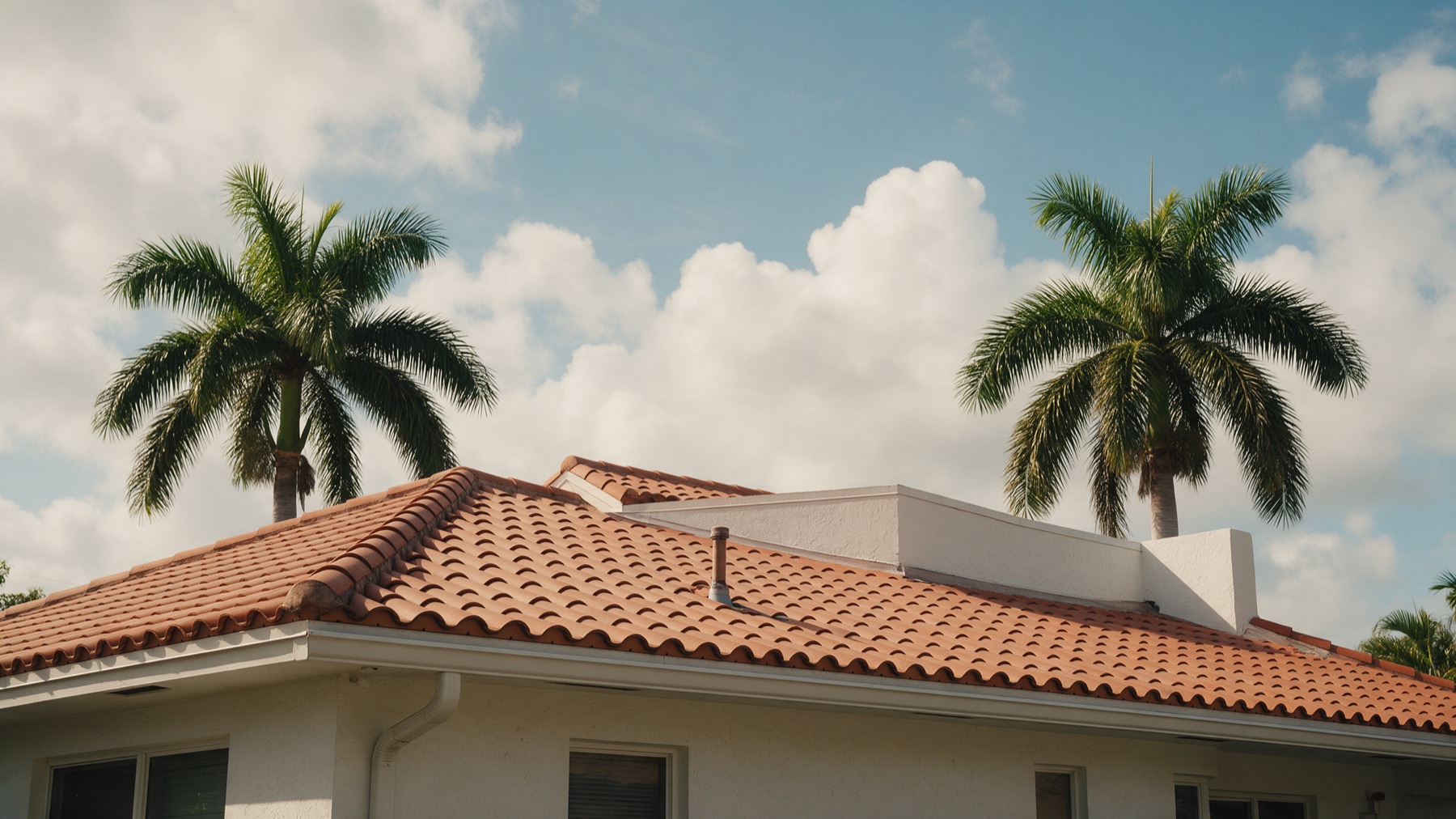
Every Miami house has a few pipes poking through the roof. They are plumbing vents, and each one is sealed by a collar called a pipe boot or vent flashing. When that seal fails, water runs down the outside of the pipe and shows up as a stain near a bathroom or kitchen ceiling. A pipe boot leak in Miami is one of the easier roof leaks to spot, and you can do most of the looking from the ground and the attic. This guide shows you how.
Quick answer: Find the vent pipes on your roof with binoculars or a phone zoom. A cracked, split or shrunken rubber collar, a gap between the collar and the pipe, a lifted flashing base, or cracked tile around the pipe are the warning signs. Confirm from the attic by looking for water trails down the pipe. Do not climb onto the roof to fix it.
What you'll need
- Binoculars or a phone with a good zoom
- A flashlight, for the attic
- Your phone, to take dated photos
- Painter's tape and a pencil, to mark any ceiling stain
- A helper, if you go into the attic or use a ladder at the eave
Step by step
- Find the pipes on the plan in your head. Vent pipes usually rise above bathrooms, the kitchen and the laundry. Walk around the house and note where each one comes through the roof.
- Look from the ground in good light. Mid-morning is best, before the roof gets dangerously hot and while the sun is high enough to light the pipes.
- Zoom in on the collar. On many roofs the seal is a rubber or similar collar that hugs the pipe. Look for cracks around the top ring, splits down the side, or a collar that has shrunk away from the pipe and left a visible gap.
- Check the base. The collar sits on a flat flashing base that should lie flat under the roof covering above it. Look for a lifted edge, rust, missing sealant, or a base that sits on top of the tile or shingle above instead of tucked under it.
- Look at the roofing around the pipe. On a tile roof, check for cracked, chipped or slipped tiles around the vent. On a flat roof behind a parapet, look for bubbles, cracks or dark staining at the base of the pipe.
- Check the pipe itself. A pipe that leans, looks crushed, or has a damaged cap can move the seal and open a gap. Note it.
- Photograph each pipe. Take a wide shot that shows where the pipe is, and a zoomed shot of the collar. Date them.
- Go to the attic, early and in daylight. Find where each vent pipe passes up through the roof deck. Look for wet or dark wood around the hole, water trails down the pipe, stains on the top plate, or wet insulation below. Stand only on solid joists. Our attic flashlight guide walks through it.
- Match it to the ceiling. Mark the edge of any ceiling stain with a pencil and tape. If the stain is near a bathroom and the attic shows water on a vent pipe, you probably have your answer. If not, remember that water can travel; see why the leak is rarely above the stain.
- Stop there. Everything after this point means touching the roof. That belongs to a licensed roofer.
What a failing pipe boot looks like
| What you see from the ground | What it usually means |
|---|---|
| Hairline cracks on the rubber collar | Sun and heat aging, early failure |
| Split collar or a visible gap at the pipe | Water can run straight down the pipe |
| Base edge lifted or sitting on top of the roofing | Water can get under the flashing |
| Rust or holes in a metal base | Corrosion, often worse near the coast |
| Cracked or slipped tile around the pipe | Water reaching the underlayment at the pipe |
| Old caulk smeared around the collar | Someone has patched it before |
Why pipe boots fail early in Miami
Sun, heat and UV. Rubber collars sit in direct sun all year. Over time they dry out, harden and crack.
Salt air. Near the coast, salt speeds up corrosion of metal bases, fasteners and storm collars. If you live near the ocean or the bay, look closely for rust streaks.
Wind-driven rain. Storms push water sideways and up under flashing edges that stay dry in ordinary rain. A boot that is a little loose may only leak in a tropical storm. Our wind-driven rain guide explains why.
Tile roofs. On tile, the underlayment is the real waterproofing, and the vent penetration is a weak point in it. A cracked tile beside a pipe can send water straight to the spot where the underlayment is cut for the pipe.
Critters and debris. Iguanas, birds and falling fronds can tear a collar or knock a pipe out of line.
What a proper repair involves in Miami-Dade
You will not do this yourself, but you should know what a good repair includes so you can judge a bid.
Miami-Dade is in the High Velocity Hurricane Zone, which has its own roofing rules in Chapter 15 of the Florida Building Code. A Miami-Dade County building presentation points out that roof penetration and flashing details must comply with the HVHZ roofing provisions, and that penetration flashings follow accepted roofing industry practice. Our HVHZ guide explains the basics. In practice, that means a roofer should:
- Replace the failed flashing or boot rather than smearing sealant over a crack
- Tie the new flashing into the underlayment correctly, which on a tile roof means lifting and resetting the tiles around the pipe
- Use roofing materials that carry the right product approval. The City of Miami's roofing permit page says roofing materials must have a Miami-Dade Notice of Acceptance or a Florida Product Approval
- Replace any cracked tile around the pipe with matching tile
Permits. The City of Miami states that a building permit is required for all roofing work, residential and commercial. Miami-Dade County guidance says some minor repair work done by the appropriately licensed contractor may be permit exempt. Rules differ by city, so ask your roofer and check with your building department. Florida's owner-builder exemption exists, but it still means permits and inspections, it makes you legally responsible, and the City of Miami limits its roofing owner-builder option to shingle roofs. It is not a shortcut.
For planning numbers, see the Miami roof cost guide. Our roof repair page explains how we approach a diagnosis.
Safety first
Safety first. Stay off the roof. Walking on tile cracks it and creates a new leak, and Miami roof surfaces can pass 150°F, so heat exhaustion is a real risk. Look from the ground first. If you use a ladder only to look at the eave, set it on firm, level ground at about a 4-to-1 angle, with a second person holding it, and keep three points of contact. OSHA says a ladder used to reach an upper level should extend at least 3 feet above it. Never use a ladder on wet or windy days, never go up when the roof is wet with rain or dew, and come down at the first sign of lightning. Stay well clear of power lines and the service drop. In the attic, step only on joists and keep away from wiring.
Stop and call a licensed roofer if…
- The rubber collar is cracked, split or has pulled away from the pipe
- The flashing base is lifted, rusted or sitting on top of the roofing
- Tile around a vent pipe is cracked, chipped or slipped
- You see water trails, dark wood or wet insulation around a vent pipe in the attic
- A ceiling stain near a bathroom or kitchen grows after rain
- A pipe leans, looks crushed or has lost its cap
- Someone has already caulked the boot and it still leaks
- The stain is near a light fixture, fan or outlet. Turn that circuit off first
- You smell mustiness or see mold around the stain
- The flat roof around a pipe shows bubbles, cracks or standing water
FAQ
How do I know if my roof pipe boot is leaking?
Look for a cracked or gapped collar from the ground, then check the attic for water trails down the vent pipe after rain. A ceiling stain near a bathroom or kitchen is a common clue.
Can I just put caulk around the vent pipe?
We do not recommend it. It means working on the roof, and sealant over a cracked boot is a temporary patch that can hide the real problem. A failed boot should be replaced and tied into the underlayment.
Why does my vent pipe only leak in heavy storms?
Wind-driven rain reaches gaps that normal rain does not. A boot that is slightly loose, or a base that is lifted on one side, may stay dry until a storm pushes water sideways under it.
Does replacing a pipe boot need a permit in Miami-Dade?
It depends on your city and the scope of the work. The City of Miami requires a permit for all roofing work, while county guidance allows some minor repairs by licensed contractors without one. Ask your roofer and your building department.
Is a pipe boot leak a sign I need a new roof?
Not by itself. A boot often fails before the rest of the roof. If the roof is old or there is damage in several places, though, a full inspection is worth it before you pay for a spot repair.
Next step
If you have photos of your vent pipes and still are not sure, a short visit settles it. Book a free roof assessment at calendly.com/karmacgroup/30min or call 305-419-0890.
Sources
MIA Roofers · Roofing performed by Premier Group, Florida Certified Roofing Contractor CCC1332855. This guide is general information, not an inspection of your roof.