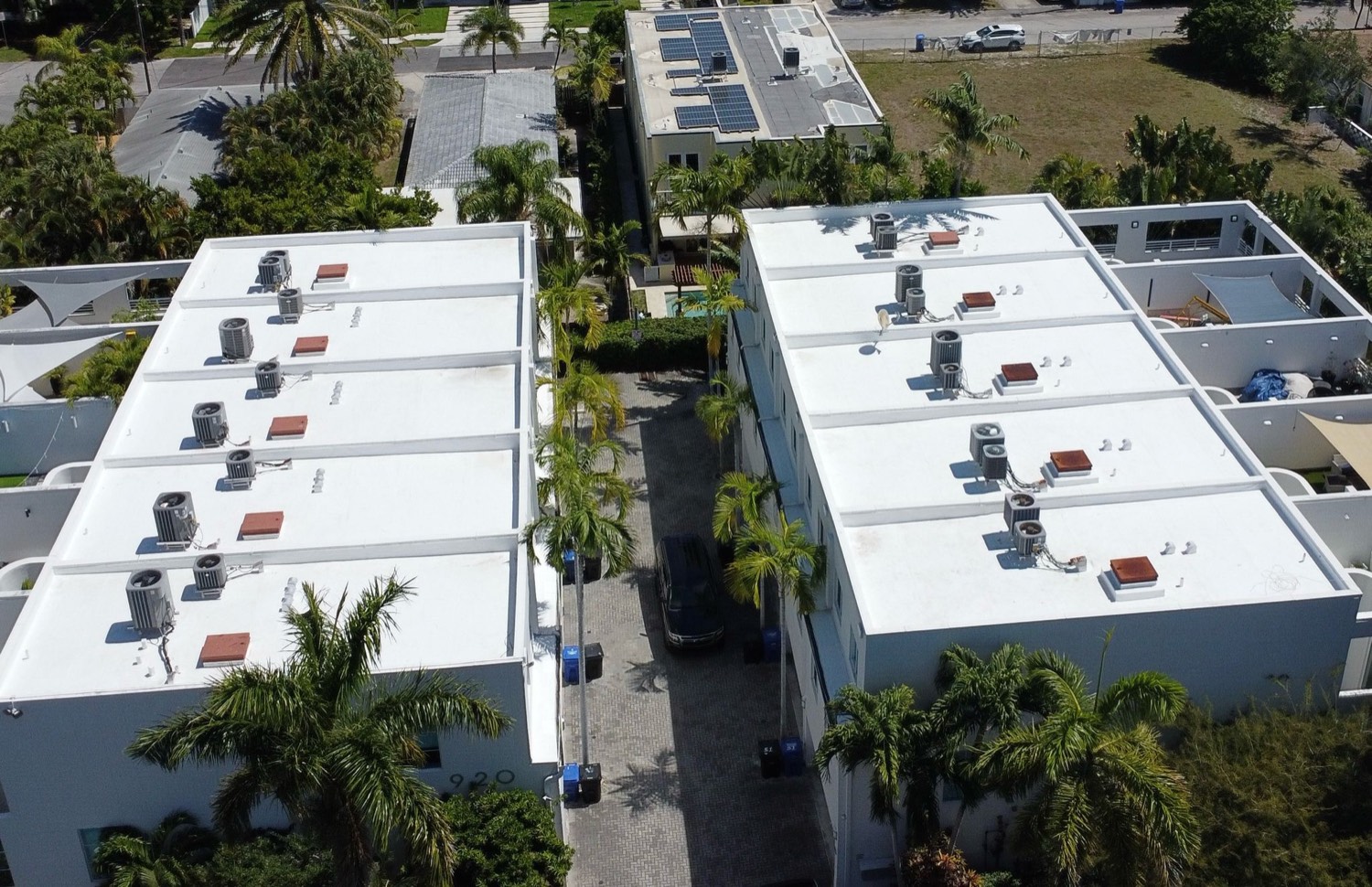
Miami-Dade's commercial and association roofing market runs on documentation. A board cannot approve what it cannot explain to its members, a reserve study needs a defensible number, and since the statutory changes that followed Surfside, structural integrity reserve studies and milestone inspections have hard deadlines attached to them.
We work to that reality: written condition assessments with photographs, remaining-life estimates that a reserve study can actually use, and phased scopes that keep a building occupied and dry throughout.
The constraint on an occupied multifamily roof is not production rate — it is that no section can be left open overnight, and that residents live above and below the work. Sections are sized so each is torn off, dried in and made watertight within a working day, weather permitting.
Miami adds its own variable: the afternoon thunderstorm. Between roughly June and October, an open roof in the afternoon is a decision, not an accident. Production is sequenced around it rather than gambled against it.
A reserve study needs a replacement cost and a remaining useful life for the roof. Both are frequently carried forward for years from a figure nobody can source, and both have moved substantially — construction costs, and the HVHZ code requirements, are not what they were five years ago.
A current condition assessment fixes that. It gives the reserve specialist a real remaining life per building or per section, and a replacement cost that reflects what the code actually requires today — including deck re-nailing and the secondary water barrier, which older reserve numbers frequently omit entirely.
| System | Installed cost / sq ft | Typical service life | Notes |
|---|---|---|---|
| Concrete tile (flat or profiled) | $14 – $24 | 30–50 yrs | The South Florida default. Heavy — the structure has to be able to carry it. |
| Modified bitumen, 2-ply (low-slope) | $9 – $16 | 15–25 yrs | The standard flat-section system here — including the flat runs behind a tile parapet. |
| TPO single-ply (low-slope) | $9 – $17 | 20–30 yrs | Reflective. Common on commercial, small multifamily and larger flat residential sections. |
| Silicone restoration coating | $4 – $8 | 10–20 yrs | Only over a sound, dry substrate, and only where the existing system is not already at the layer limit. |
How to read these. Ranges are Miami-Dade market pricing for planning and budgeting, not a quote. Real numbers move with roof geometry and pitch, how much deck has to be replaced once the tile is off, the secondary water barrier the HVHZ requires, tear-off depth, access and staging, and how many squares of tile can be salvaged and reset versus supplied new.
These apply throughout Miami-Dade County. Permitting and local specifics are on each service area page, and the full picture is on the HVHZ code page.
Approved assemblies, deck attachment, the secondary water barrier and the inspection sequence apply to a hundred-thousand-square-foot roof exactly as they do to a house. At scale, the perimeter and corner attachment zones become a much larger share of the job.
Florida requires milestone structural inspections and structural integrity reserve studies for certain condominium buildings on a statutory schedule. Roof condition and remaining life feed both. Confirm your building's specific obligations and deadlines with your association counsel — the requirements have changed repeatedly since 2022.
Primary and secondary drainage paths must be sized so a blocked primary drain does not load the structure. On large older roofs, overflow provision is frequently missing or set at the wrong height.
A commercial job in Miami-Dade may need more than a roofing permit — crane or lift placement, right-of-way occupancy, after-hours work agreements. On a tight urban site those approvals drive the schedule more than the roofing does.
The rule that decides most jobs: Miami-Dade and Broward are the only two counties in the country designated a High Velocity Hurricane Zone. The HVHZ provisions of the Florida Building Code are a stricter, separate rulebook: products need their own approval, the deck has to be sealed, attachment is tested in the field, and there are more inspections. A roofing spec that is perfectly legal in Orlando or Tampa can be non-compliant here without a single word changing on the page.
Low-slope commercial replacement generally runs $9 to $17 per square foot installed depending on system, insulation, deck condition and access. A silicone restoration over a sound substrate is $4 to $8. At association scale the variables that move the number most are phasing, access and how much deck is found once the roof is open.
Yes, and that is the normal case. Work is staged so that no section is left open overnight and every unit is dry every night. During the summer storm season, production is sequenced around the afternoon pattern rather than gambled against it.
Yes. A written condition assessment with photographs, remaining-life estimates per building or section, and replacement costs that reflect current HVHZ requirements — in a form a reserve specialist can use directly and a board can circulate to owners.
Yes, and the documentation and phasing requirements that come with association work are built into how we scope it. What boards most often tell us is missing from other bids is a clear phasing plan and a written basis for the number.
Twenty minutes on site. A written report with photos and numbers. No obligation.
Pick a time on the calendar. We walk the roof, photograph what we find, and send a written report with real numbers.
Pick a time that suits you — 30 minutes, no obligation.
Active leak? Call 305-419-0890 instead; that gets triaged the same day.