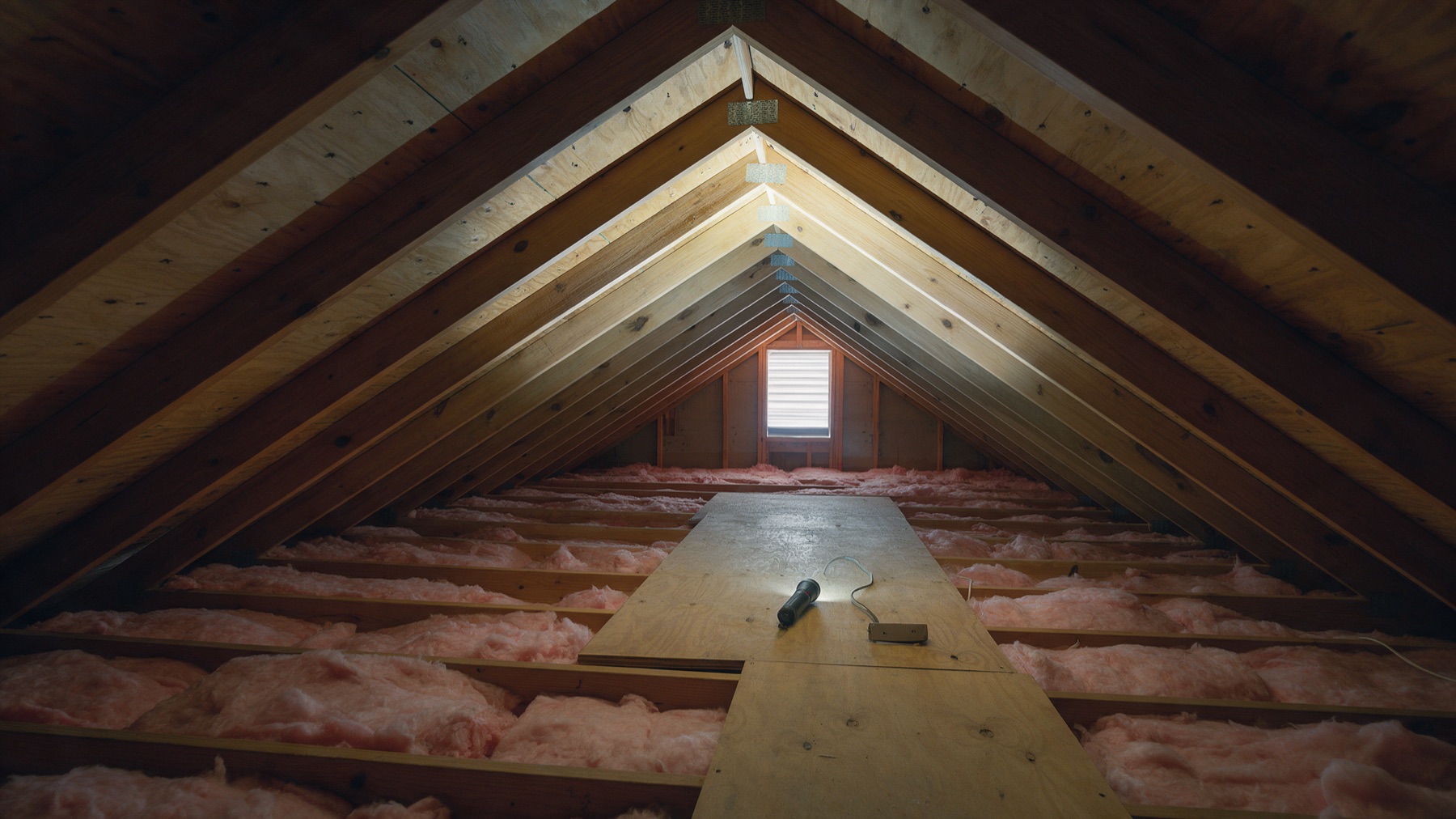
You have a stain on the ceiling and no idea where the water is coming in. The roof is the obvious suspect, but on a Miami home the roof usually hides the answer from outside. The attic does not. Ten minutes up there with a flashlight, on a dry day, will often show you the entry point, or at least the direction to look. This guide covers how to find a roof leak from inside your Miami attic without hurting yourself or your ceiling.
Quick answer: Go into the attic on a dry, cool morning with a bright flashlight and a phone. Walk only on the joists or a board laid across them. Look at the underside of the roof deck for dark stains, damp wood, and rusted nail tips, then trace any wet insulation back uphill to the source. Photograph what you find and hand it to a licensed roofer. Do not go onto the roof to chase it.
What you'll need
- A bright flashlight, plus a headlamp so both hands are free
- Your phone for photos and a tape measure for distances
- A sturdy plank or plywood board to span the joists
- A second person who knows where you are
- Long sleeves, long pants, gloves, an N95 or better dust mask, and eye protection
Step by step
- Pick the right day. Go up the morning after rain, before the attic heats up. A damp stain is easier to read than a dry one, and the air is bearable. Never go up in the afternoon in summer, and never during a storm.
- Note where the ceiling stain is. Measure from two walls and write it down. You will want that number once you are in the attic, because the entry point is rarely directly above the stain.
- Check your footing before you step. Ceiling drywall will not hold a person. Step only on the joists or on a board spanning them. Test each step with your hand before you trust it.
- Look for wiring first. Scan the area with the flashlight for cables, junction boxes and anything damaged, and keep clear of wet insulation near live wiring. If you see frayed wire or a wet junction box, stop and come back out.
- Switch off the lights and look for daylight. With the attic dark, daylight showing through the roof deck is a gap. Mark it. Check around pipes and vents, which are the most common weak points.
- Shine the flashlight along the underside of the roof deck at a low angle. Raking light shows dark rings, water trails, and rippled or delaminating plywood. Look for rusted nail tips with a halo around them.
- Press gently on suspect wood. Soft or spongy plywood means water has been getting in for a while. Do not dig at it. Photograph it.
- Trace the water uphill. Water runs down the rafters and along the deck before it drips. Follow a stain or wet insulation toward the ridge to find where it starts. Mark both ends.
- Photograph everything, with a tape measure in the frame. Take a wide shot and a close-up for each location, and note its distance from the nearest gable wall.
- Come back out and write down the roof feature above each mark. A pipe boot, a valley, a chimney, a skylight, or the flat section behind the parapet. That tells the roofer where to start.
Why the leak is not above the stain
Water follows gravity, but it also follows the framing. On a Miami roof, rain gets in at one point, runs down the underside of the deck or along a rafter, and drips onto insulation well away from the source. The ceiling stain shows where the water finally came through, not where it entered. That is why we start in the attic and work uphill. For more on how water moves, our guide to wind-driven rain leaks explains why Miami storms push water into places a straight-down rain never reaches.
On a clay or concrete tile roof, the tile is not what keeps the rain out. The underlayment under the tile does that job, and it fails long before the tile does. A leak can show up in the attic with every tile on the roof looking perfect from the street. Walking on tile to look for the problem cracks it, and the crack you create is a new leak. This is why the attic is the safer place to start.
What the marks usually mean
| What you see | What it often points to |
|---|---|
| Dark ring or water trail on the deck around a pipe | A cracked or worn pipe boot or vent flashing |
| Stains along a line running downhill from a valley | Valley flashing or underlayment failure |
| Rusted nail tips with a damp halo | Moisture from condensation, a small leak, or both |
| Wet insulation under a flat section | Membrane failure, a blocked scupper or drain, or failed flashing at the parapet |
| Damp area near a bathroom or kitchen vent | A vent duct leaking moisture into the attic, not the roof |
| Stain in a ring near an air handler | Condensation or a drain-line problem, not a roof leak |
If you also have a flat roof section, the roof inspection service page explains how a licensed roofer checks the flat area, and why standing water on it is worth taking seriously.
Heat, humidity and Miami attics
An attic in Miami in summer is not a pleasant place. Surfaces and air in an attic get very hot, and heat illness is a real risk. OSHA's guidance on attic work flags falls through the ceiling, electrical hazards, and heat as the main dangers for anyone working in one. Go early, keep it short, take water, and leave at the first sign of dizziness, nausea or a headache. If you feel unwell, come out and cool down.
Safety first
Safety first. Stay off the roof. This guide is for the attic only. If you use a ladder to reach the attic hatch, set it on firm, level ground at roughly a 4-to-1 angle, keep three points of contact, have a second person hold it, and never use it in wet or windy weather. Do not touch wet insulation near wiring. Keep the attic time short in hot weather and drink water. Do not work alone.
If you suspect a leak is active during rain, do not go into the attic to look. Put a bucket under the drip from below and call a roofer.
Stop and call a licensed roofer if…
- You see daylight through the roof deck, or a hole you can fit a finger into
- Plywood is soft, sagging, black, or crumbling
- Insulation is soaked, or water is dripping steadily during or after a storm
- You find stains in more than one place, or a stain that is spreading
- Wiring, a junction box or a light fixture is wet or damaged
- You smell mold, or see mold spread over the deck or rafters
- The leak is near a skylight, chimney, valley or the flat section behind the parapet
- You are unsure whether the marks come from the roof, the AC, or plumbing
In Miami-Dade, most roof repairs and all replacements need a permit, and the permit should be pulled by the licensed contractor. Roofing in the High Velocity Hurricane Zone follows specific product and inspection rules, which our HVHZ guide explains. Do not try to patch the roof yourself.
FAQ
Can I find a roof leak without going into the attic?
Sometimes. From the ground you can look for missing or slipped tile, cracked boots, and stains on the ceiling. But the attic gives you the underside of the deck, and that is where the trail usually shows. If the attic is not safely accessible, a licensed roofer can check it for you.
How long should I stay in a Miami attic?
As short as you can. Heat and humidity build quickly, and the risk goes up in the afternoon and in summer. Go in the morning, take water, set a time limit, and leave if you feel dizzy or unwell.
Is it a roof leak or condensation?
Both can leave stains, and sometimes they happen together. A leak tends to follow rain and run in a line from a roof feature. Condensation tends to show up around cold surfaces like AC ducts and air handlers, or when a vent dumps humid air into the attic. If you cannot tell, ask a roofer to look.
What should I photograph for my insurer?
Take wide and close-up shots of each stain, with a tape measure in frame, and note the date. Do not rely on this as advice on a claim. Check your policy and talk to your agent or carrier about notice requirements.
How much will a leak repair cost?
It depends on the cause and the roof type. Our Miami-Dade roof cost planning ranges give a starting point, but a roofer needs to see the leak before quoting anything. A roof repair estimate should list what is being fixed and why.
Get it looked at
If you have found a stain, a damp patch, or a spot you are unsure about, we can look at it. Book a free roof assessment at https://calendly.com/karmacgroup/30min or call 305-419-0890.
Sources
MIA Roofers · Roofing performed by Premier Group, Florida Certified Roofing Contractor CCC1332855. This guide is general information, not an inspection of your roof.