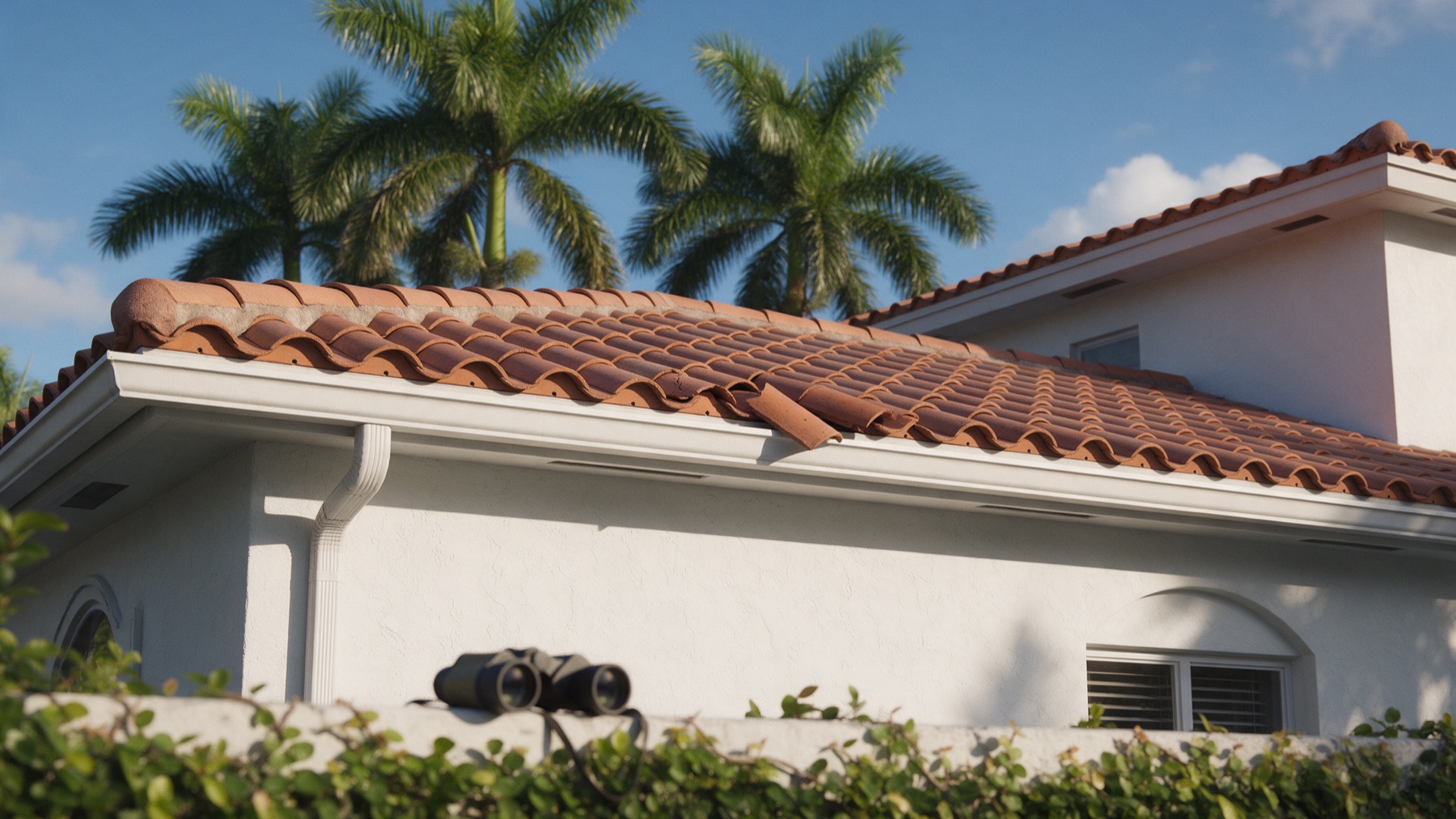
A cracked roof tile in Miami rarely leaks on day one. The underlayment beneath does the waterproofing, but a broken or slipped tile exposes it to sun, rain and debris until it fails too. The good news is that you can find most cracked and slipped tiles from your yard, with binoculars and a phone, without setting foot on the roof. Here is how, what each sign means, and when to call a roofer.
Quick answer: Walk around the house in mid-morning light with binoculars or a phone zoom. Look for broken lines in the tile pattern, gaps, dark shadows, tiles sitting higher or lower than their neighbors, tile pieces in the gutter or on the ground, and missing ridge or hip mortar. Photograph what you find and have a licensed roofer replace the tiles. Do not walk on the roof to check.
What you'll need
- Binoculars, or a phone with a good zoom
- Your phone camera, for dated photos
- A printed or sketched outline of your roof, to mark what you find
- A helper, if you look from a ladder at the eave
Step by step
- Pick your time. Mid-morning on a dry, calm day is best: enough light to see, with small shadows that show cracks and gaps.
- Walk the whole house. Go around every side and step back far enough to see each roof plane. The far side of the street often gives the best angle.
- Read the pattern first. Scan along each row. A cracked or slipped tile usually shows up as a break in the rhythm: one tile out of line, a gap, or an odd shadow.
- Zoom in on anything that looks off. With binoculars or a phone zoom, look for:
- A visible crack line across a tile, or a missing corner or chip
- A tile that has slid down and overlaps the one below more than its neighbors
- A gap where you can see dark underlayment beneath
- A tile sitting higher than the rest, which can mean it has lifted or something is under it
- Check the ridges and hips. The tiles along the peaks and the angled corners are often set in mortar. Look for cracked or missing mortar, gaps under the cap tiles, and caps that have shifted.
- Check the edges. Look along the eaves and rakes for broken starter tiles, missing eave closures, and cracked tiles at the gable ends. These take the brunt of wind.
- Look around everything that sticks up. Tiles next to vent pipes, skylights, chimneys, walls and solar mounts get cut and handled more, so they crack more. Our guides to pipe boot leaks and skylight leaks cover those spots in detail.
- Check the ground and the gutters. Clay or concrete fragments in the gutter, on the patio or in the planting beds are a strong clue that something above has broken.
- Photograph and mark. Take a wide shot and a zoomed shot of each problem, mark it on your sketch, and keep the dates.
- Check the attic after the next rain. If you can do it safely, look on the underside of the roof deck below any marked spots for dark or wet wood. Our attic flashlight guide explains how.
What each sign usually means
| What you see from the ground | What it usually means | How soon to act |
|---|---|---|
| Hairline crack, tile still in place | Early damage; underlayment probably still covered | Have it checked at your next inspection |
| Broken corner or missing piece | Underlayment partly exposed to sun and rain | Book a repair soon |
| Tile slid down out of line | Fastener or adhesive has let go | Book a repair soon; it can fall or blow off |
| Gap with dark underlayment showing | Underlayment fully exposed | Call now, especially in hurricane season |
| Cracked or missing ridge mortar | Cap tiles can loosen in high wind | Book a repair before the next storm |
| Tile fragments in the gutter | Something above is broken | Find the source and call |
Why tile cracks and slips in Miami
Foot traffic. This is the big one. Tile is brittle under a point load. A cable installer, painter or AC tech walking across the roof can crack several tiles in one trip. If anyone has been up there recently, check the path they took.
Storms and debris. Fronds, coconuts and wind-blown debris chip and break tile. After a storm, our tile roof debris guide covers what to leave alone.
Attachment letting go. Tiles are held by fasteners, mortar or foam adhesive, depending on the system. In Miami-Dade, a county presentation on the 2023 code changes notes that the tile assembly is tested for how well its attachment resists the rotational force from wind uplift. When that attachment weakens with age, a tile can slide out of line long before it breaks.
Heat and age. Sun and heat wear down ridge mortar and the underlayment below. The tile can look fine while the layer under it is near the end.
What a proper tile repair involves in Miami-Dade
Miami-Dade is in the High Velocity Hurricane Zone, with its own roofing rules in Chapter 15 of the Florida Building Code. Section 1518.8, quoted in the county's 2023 code-change presentation, says all tile and tile systems must be tested under Section 1523. See our HVHZ guide for the background. In practice a sound repair means:
- Replacing broken tiles, not gluing them. A Florida Building Commission staff analysis notes that existing concrete tile can be reinstalled during a repair, but damaged, cracked or broken tile cannot.
- Matching tile. The same analysis says used or salvaged concrete tile that meets current code for new materials may be allowed, subject to the building official's approval. A good roofer will tell you where replacement tile is coming from.
- Lifting the tiles around the damage to check the underlayment underneath, then resetting them with the correct attachment method.
- Product approval. The City of Miami's roofing permit page says all roofing materials must have a Miami-Dade Notice of Acceptance or a Florida Product Approval.
Permits. The City of Miami says a building permit is required for all roofing work, residential and commercial, and its owner-builder roofing option is limited to shingle roofs. Rules for small repairs can differ in other cities and unincorporated Miami-Dade, so ask your roofer and check with your building department. Never accept unpermitted work.
For planning numbers, see the Miami roof cost guide. If the underlayment is near the end of its life, our tile roof replacement page explains what that job involves, and the Florida Building Code 2026 update explains the code change coming on December 31, 2026.
Safety first
Safety first. Never walk on a tile roof. Your weight cracks tile, and you can create the very leak you were looking for. Tile is also slippery, especially with dew or algae, and Miami roof surfaces can pass 150°F. Look from the ground. If you use a ladder only to look along the eave, set it on firm, level, dry ground at about a 4-to-1 angle, keep three points of contact, and have a second person hold it. OSHA's rule for ladders used to reach an upper level is that the rails extend at least 3 feet above it. Never use a ladder on wet or windy days or when lightning is around. Stay well clear of power lines and the service drop. Work early to avoid heat exhaustion.
Stop and call a licensed roofer if…
- You can see dark underlayment through a gap or broken tile
- A tile has slid out of line or looks loose, especially near an edge or ridge
- More than one or two tiles are cracked in the same area
- Ridge or hip mortar is cracked, missing, or a cap tile has shifted
- You find tile fragments in the gutter or on the ground and cannot see the source
- Tiles around a vent, skylight, wall or solar mount are cracked
- There is a ceiling stain, wet attic wood or a musty smell below a damaged area
- Someone recently walked on the roof and you can see damage along their path
- It is hurricane season and a storm is in the forecast
- Your tile roof is old enough that you are not sure the underlayment has life left
FAQ
Can a cracked roof tile cause a leak?
Not always right away, because the underlayment under the tile is the real waterproofing. A crack lets sun, water and debris reach that layer, though, and over time that is how many Miami tile roof leaks start.
How do I check my tile roof without walking on it?
From the ground, with binoculars or a phone zoom, in mid-morning light. Scan each row for breaks in the pattern, gaps and odd shadows, check the ridges and edges, and look in the gutters for fragments.
Can I replace a broken roof tile myself?
We do not recommend it. Getting to the tile means walking on the roof, which breaks more tile, and in Miami the repair has to meet HVHZ attachment rules and usually needs a permit. A licensed roofer is the right call.
Is one slipped tile an emergency?
Usually not, but do not ignore it. A slipped tile can blow off in high wind and expose the underlayment. Get it reset before the next storm, and sooner if you can see underlayment.
Does insurance cover cracked roof tiles?
It depends on your policy and the cause. Photograph the damage with dates and ask your agent or carrier how your policy handles it.
Next step
If you have spotted a cracked or slipped tile and want a second opinion, send us your photos or book a free roof assessment at calendly.com/karmacgroup/30min. You can also call 305-419-0890.
Sources
MIA Roofers · Roofing performed by Premier Group, Florida Certified Roofing Contractor CCC1332855. This guide is general information, not an inspection of your roof.