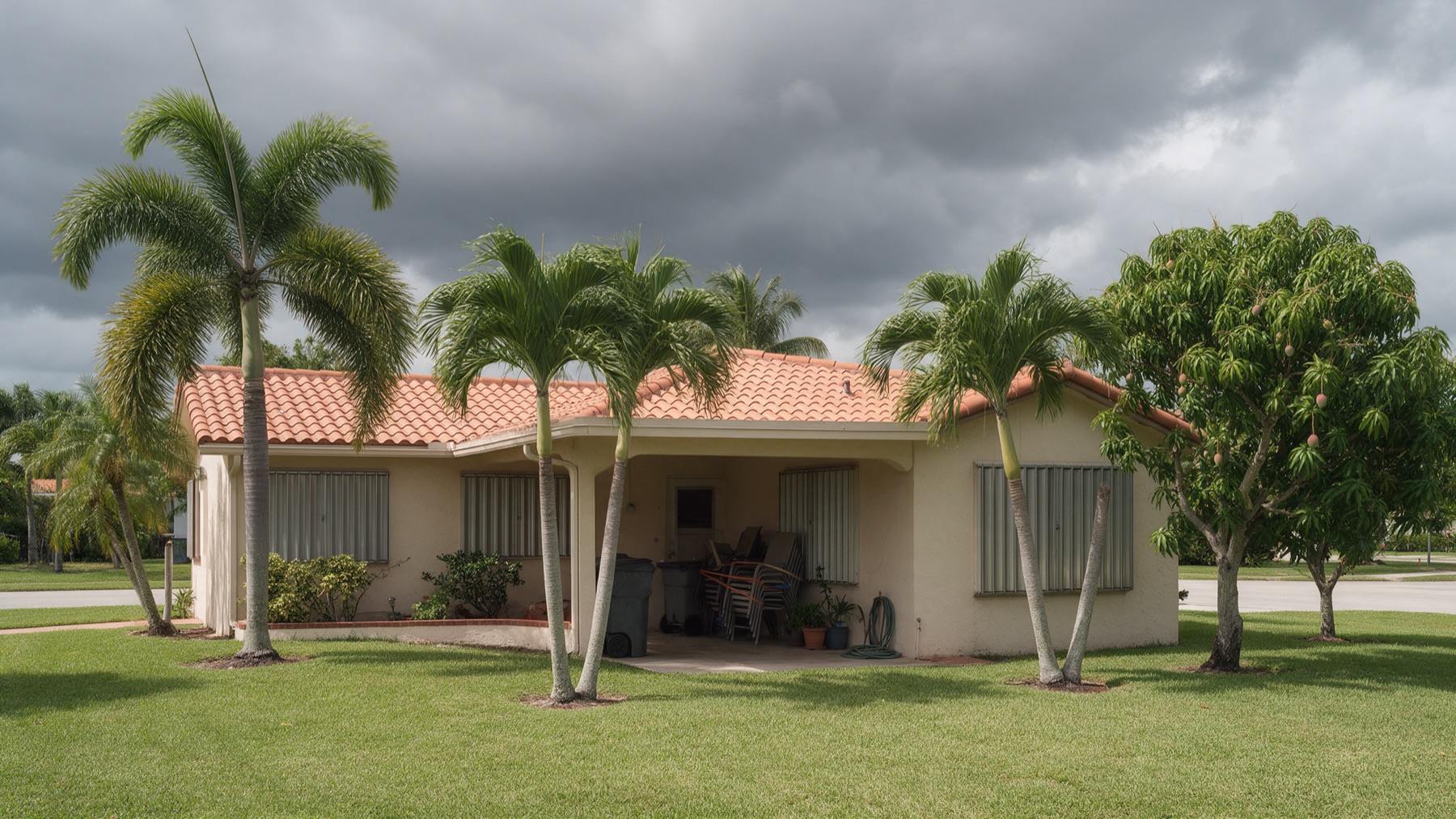
The roof itself is usually not what fails first in a Miami storm. What fails first is the stuff around it: the patio chair that goes through a window, the trash cart that lands on the tile, the palm frond that blocks the scupper so the flat roof fills like a bathtub. Knowing what to secure around your roof before a hurricane hits Miami is a yard-and-perimeter job you can do from the ground in an afternoon. This guide tells you what to move, what to tie down and what to leave to a professional. None of it involves climbing onto the roof.
Quick answer: Once a tropical storm warning, hurricane watch or hurricane warning is issued for Miami-Dade, the county code requires loose outdoor objects to be stored inside or braced and fastened to a fixed structure. Bring in furniture, bins, plants, toys and tools; tie down what can't come in; close the shutters; and leave the trees and the roof-mounted equipment alone at that point. Tree work and bulky-waste piles have to be finished before the watch goes up, not during it.
What you'll need
- Your phone, for photos and the National Hurricane Center forecast
- Binoculars or a phone zoom, to look at the roof from the ground
- Ratchet straps or rope, and a few bungee cords
- A garage, shed, covered patio or spare room with floor space
- A helper for anything heavy
Step by step
- Check the forecast and the clock. The trigger that matters in Miami-Dade is the first of a tropical storm warning, a hurricane watch or a hurricane warning. Everything that needs a truck, a chainsaw or a trash pickup has to be done before that point.
- Finish tree and palm work early, or skip it. Miami-Dade's solid waste department says not to begin tree pruning or cleanup, and not to put trash on the curb, once a tropical storm or hurricane watch or warning is in effect. Cut fronds at the curb during a storm are projectiles. If a limb overhangs the roof and the storm is days out, have a tree professional cut it and haul it away the same day.
- Get rid of yard and household waste now. County solid waste customers can schedule a bulky waste pickup through 311 before a storm threatens, or take cuttings and trash to a Neighborhood Trash and Recycling Center. Don't leave a pile on the swale and hope.
- Walk the perimeter. Treat everything outdoors as something that could hit the roof or a window in 100 mph wind: chairs, umbrellas, grills, pots, hose reels, toys, bikes, ladders, lumber, tools. Sort it into "comes inside" and "can't come inside."
- Bring in what you can. Furniture, cushions, plants, toys, bikes and tools go in the garage, a shed or the house. The county's guidance is to put trash and recycling carts in a garage, utility shed or covered patio.
- Tie down what can't come in. A gas grill and its propane tank stay outdoors. Shut the tank valve and strap the grill to a post or fixed structure. Strap a trampoline frame down or take it apart. The county code allows bracing, bundling or fastening loose objects to a fixed structure as an alternative to storing them.
- Look at the roof from the ground with binoculars. You are checking for loose material, not inspecting the roof. A tarp from an earlier repair, a leftover stack of tile, a lifting ridge cap, a wobbling satellite dish. Note it and photograph it. Do not go up.
- Clear what feeds the drains. Pull fronds and leaves out of gutters you can reach with a pole from the ground or from a short ladder at the eave. Look at the scuppers on any flat section from below; water streaks on the stucco under a scupper mean it has been overflowing. Blocked drainage is how a flat roof behind a parapet ends up holding hundreds of pounds of water. If you can't reach it safely, leave it for the roofer.
- Close shutters and panels while the ground is dry and the wind is calm. A breached window pressurizes the house and loads the roof from below.
- Photograph everything. Wide shots of each side of the house and zoomed shots of the roof. Our guide to photographing your roof before a storm covers the routine.
- Stop when the wind starts. A ladder in wind is more dangerous than any loose chair.
The Miami-Dade loose objects rule
In Miami-Dade, securing loose objects is a code requirement, not a suggestion. The City of Miami's hurricane guide points to Section 8B-18 of the county code, which defines a loose object as any object in an outdoor location of a residential, commercial or industrial property that may become windborne, with outdoor chairs and tables, display racks, bicycles and toys as examples. When a severe weather advisory is issued, meaning a tropical storm warning, a hurricane watch or a hurricane warning, those objects have to be stored in a building or braced, bundled or fastened to a fixed structure.
The practical reading: by the time the watch goes up, the yard should already be clear. Your city may add its own rules; your building department can tell you.
What goes where
| Item | Before the watch | After the watch | Why it matters for the roof |
|---|---|---|---|
| Patio furniture, cushions, umbrellas | Inside, or stacked and strapped | Must be secured (county code) | Chairs go through windows and crack tile |
| Trash and recycling carts | Garage, shed or covered patio | Not at the curb | A loaded cart on its side is a battering ram |
| Grill and propane tank | Valve shut, strapped outdoors | Leave it strapped | Never bring propane indoors |
| Tree and palm trimming | Done and hauled away | Do not start | Cut fronds at the curb become debris |
| Bulky waste pile | Scheduled through 311 and collected | Do not place | Loose piles end up on roofs and in drains |
| Gutters and scuppers | Cleared from the ground or eave | Leave it | Blocked drains flood flat roofs |
| Rooftop dish, solar, AC on the roof | Checked by a licensed contractor | Leave it | Not a DIY job on any roof, never on tile |
Rooftop equipment: look, don't touch
A roofing industry report on the 2004 Florida hurricanes found satellite dishes blown off roofs, and that dishes on a pole set in a block-weighted metal pan were inadequate in high-wind areas. The fix is a properly anchored mount installed by the provider or a contractor in the off-season, not a homeowner on the roof the day before a storm. The same goes for cameras, rooftop AC units and solar panels.
In the High Velocity Hurricane Zone, rooftop structures and equipment have to be attached to the Florida Building Code's HVHZ wind requirements, which is one reason rooftop work here goes through a licensed contractor and a permit. Our HVHZ building code guide explains what that means. If a dish, camera, vent cap or panel looks loose through binoculars, that is a call to the installer or a roofer. On tile, walking up to check is how the next leak starts.
Ground-mounted AC condensers are different: check from the ground that their tie-down straps are present and tight, and have an HVAC contractor add or replace them if not.
Safety first
Everything in this guide happens from the ground. Never walk on a tile roof: it cracks under foot and makes the leak you were trying to prevent. If you use a ladder to reach a gutter at the eave, set it on firm, level, dry ground at a 4-to-1 angle, extend it 3 feet above the edge, keep three points of contact and have a second person hold it. Never use a ladder in wind or rain. Stay well clear of power lines and the service drop, especially when moving ladders, poles and umbrellas. Miami roof surfaces run over 150°F in the afternoon, so work early, drink water and stop if you feel dizzy. Propane stays outside with the valve shut. A generator runs outdoors only, away from windows and doors.
Stop and call a licensed roofer if…
- Binoculars show a lifted ridge cap, a slipped tile, or flashing standing proud of the roof
- A satellite dish, antenna, camera or vent cap moves in a normal breeze
- A tarp from an earlier repair is still up, or a crew left material on the roof
- A flat section is holding water, or a scupper overflows in ordinary rain
- Solar panels, conduit or mounts look loose, or you can see daylight under a rail
- A palm or limb is resting on the roof and the storm is days away
- You are not sure whether a rooftop item is anchored, and you were about to climb up to check
Our hurricane and storm damage service covers pre-storm checks and post-storm repairs. If a flat section already holds water in dry weather, see flat roof replacement, and our Miami roof cost guide gives planning ranges.
FAQ
When do I legally have to secure loose items in Miami-Dade?
Under Section 8B-18 of the county code, when a tropical storm warning, a hurricane watch or a hurricane warning is issued for any part of Miami-Dade. Do it earlier; the watch is also when you stop using ladders.
Can I trim my trees once a hurricane watch is issued?
The county's solid waste department says not to begin tree pruning or cleanup, and not to put trash on the curb, during a tropical storm or hurricane watch or warning. Do it earlier, haul the cuttings away, or leave it.
Should I take my satellite dish down before a hurricane?
Not yourself, and not from a roof. If the dish sits on a weighted pan rather than a bolted mount, have the provider re-mount it in the off-season. The day before a storm, leave it and photograph it.
Get the roof checked before the next watch
If anything on or around your roof looked loose through the binoculars, book a free roof assessment or call 305-419-0890. We'll tell you what needs securing and what can wait.
Sources
MIA Roofers · Roofing performed by Premier Group, Florida Certified Roofing Contractor CCC1332855. This guide is general information, not an inspection of your roof.