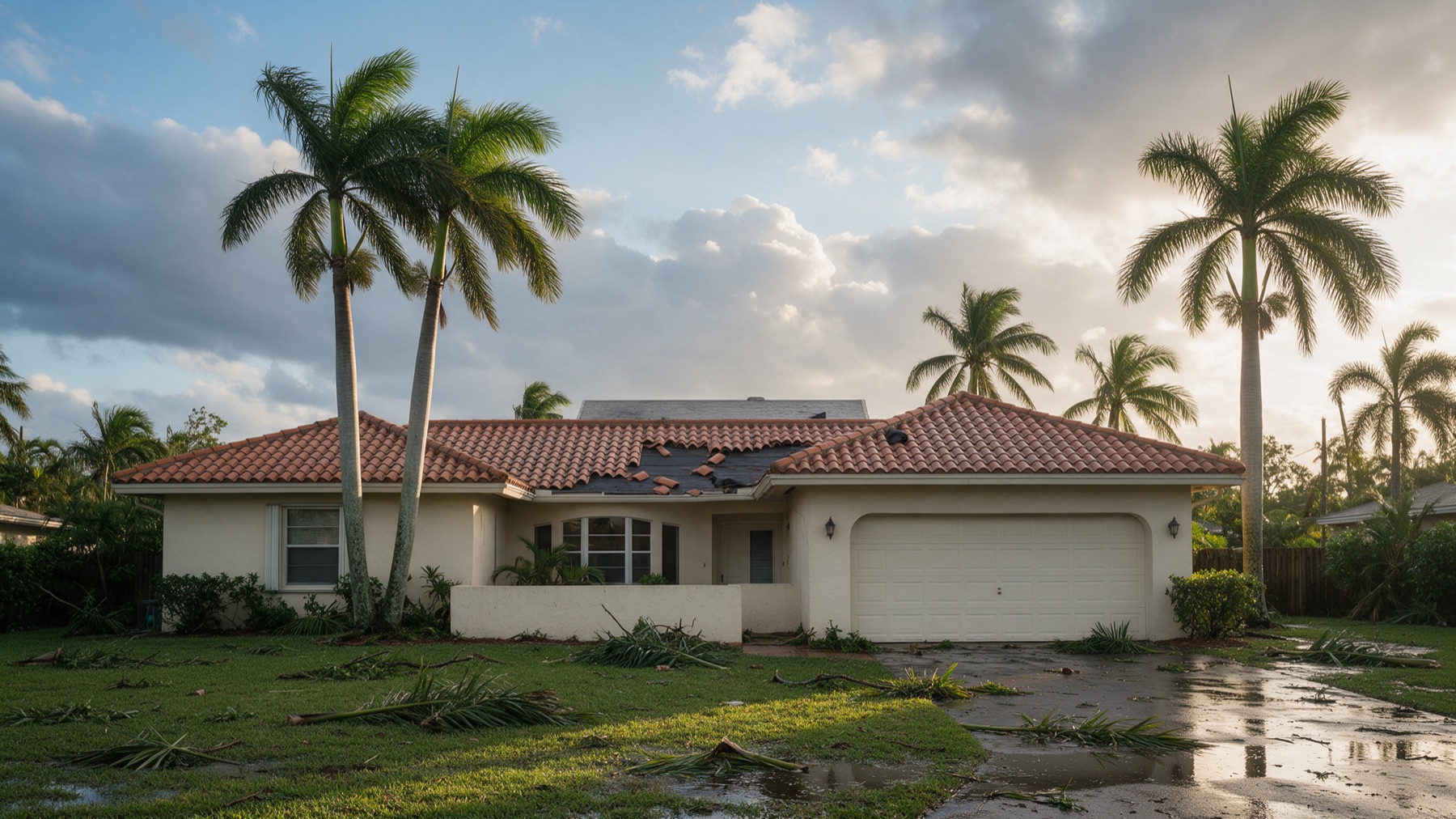
The storm has passed, the power may or may not be back, and you're standing in the yard wondering whether the roof made it. Most hurricane roof damage in Miami isn't the dramatic kind you see on the news. It's a few slipped tiles, a lifted ridge cap, a peeled corner of the flat roof behind the parapet — small things that turn into ceiling stains three weeks later. This guide shows you how to check your roof after a hurricane in Miami without climbing onto it, how to record what you find so your insurance claim holds up, and exactly where to stop.
Quick answer: Wait until the wind and rain have fully stopped and it's daylight. Walk the property from the ground with binoculars or your phone's zoom, photograph every side of the roof, then check the attic and ceilings for water. Don't climb onto a tile roof, and don't go near downed lines. Report damage to your insurer promptly — in Florida, the initial claim must be filed within one year of the date of loss.
What you'll need
- Binoculars or a phone with a good zoom (a drone works too, if you're comfortable flying one legally)
- A phone for dated photos and video
- A flashlight for the attic
- A notepad, or a notes app, to record what you see and when
- Shoes with good grip — the yard will be full of debris
That's it. You don't need a ladder for most of this, and for the parts where a ladder helps, read the safety section first.
Step by step
- Wait for it to be genuinely safe. No wind gusts, no lightning, full daylight. A "calm" eye of a storm is not the end of the storm.
- Check for hazards before anything else. Look for downed or sagging power lines, a damaged service drop where the lines meet your house, gas smells, and standing water near anything electrical. If you see any of these, stay clear and call FPL or 911 — the roof can wait.
- Walk the full perimeter from the ground. Go slowly around the whole house. Look at each roof plane from at least two angles. Use binoculars or zoom rather than getting closer.
- Look for the obvious first. Missing tiles or shingles, bare patches of underlayment (usually black or grey), tiles sitting at odd angles, ridge or hip caps that have shifted, and anything bent at the roof edge.
- Then look for the subtle. On tile roofs, look for tiles that have slipped down a few inches — the row line will look jagged. On shingle roofs, look for creases or lighter rectangles where a shingle folded back and laid down again. On flat sections, look for corners or edges that are curled up.
- Check the edges and the metal. Drip edge, gutters, and the flashing where the roof meets a wall or chimney. Bent or pulled-away metal is a strong sign of wind damage.
- Look at what's on the ground. Pieces of tile, shingle granules collecting at downspout outlets, strips of metal, or bits of underlayment in the yard all tell you something left the roof.
- Go into the attic (if you have one you can access safely) with a flashlight. Look for wet insulation, daylight where there shouldn't be any, and dark stains on the underside of the deck.
- Check every ceiling inside. Pay extra attention to rooms under the flat sections — Florida rooms, carports, rear additions — and around skylights.
- Photograph and video everything as you go, inside and out, before anything is moved or covered.
How to document roof damage for your insurance claim
Good documentation is often the difference between a smooth claim and an argument. A few habits make a real difference:
- Take wide shots first, then close-ups. A wide shot of the whole side of the house shows where the damage is; the close-up shows what it is.
- Make sure the photos are dated. Most phones embed the date automatically. Don't edit or crop the originals — save copies if you need to.
- Record a slow video walk-around of the exterior and every affected room inside, narrating what you see.
- Photograph the debris before you clean it up, including tiles or shingles in the yard.
- Keep every receipt for anything you spend to prevent further damage — tarps, buckets, a dehumidifier. Ask your insurer how they handle these costs.
On timing: under Florida Statute 627.70132, an initial or reopened property insurance claim must be reported to the insurer within one year of the date of loss, and a supplemental claim within 18 months. Your policy may have its own notice requirements too. Report early and confirm the details with your agent or carrier — this guide isn't insurance advice.
If you have photos of your roof from before the storm, find them now. They're the single most useful thing an adjuster can see. And if you don't have any, take a full set next spring before hurricane season.
What storm damage actually looks like on a Miami roof
| Roof type | What to look for from the ground | Why it matters |
|---|---|---|
| Clay or concrete tile | Missing, cracked or slipped tiles; jagged row lines; displaced ridge caps | The tile protects the underlayment. Once tile moves, wind-driven rain can reach it. |
| Asphalt shingle | Missing shingles, creased tabs, granules piled at downspouts | A creased shingle has lost its seal and will likely leak in the next storm, even if it looks flat. |
| Metal | Bent panels, lifted seams, missing fasteners at the edges | Metal tends to fail at the perimeter first. |
| Flat / low-slope | Curled edges, blisters, ponding water, debris on the surface | This is where most Miami leaks start, and it's often hidden behind a parapet. |
Wind-driven rain is the reason small damage matters here. In a Miami storm, rain moves sideways and can push under a lifted tile or a loose flashing that would never leak in ordinary rain.
Safety first
Don't climb onto a tile roof. Walking on tile cracks it — you can create the very leak you were trying to find. Don't go up at all while the roof is wet, while it's still windy, or while there's lightning anywhere nearby. If you use a ladder at the eave to look at gutters or a flat section, set it on firm, level ground at roughly a 4-to-1 angle (one foot out for every four feet of height), extend it at least 3 feet above the edge, keep three points of contact, and have someone hold it. Stay well away from power lines. And in Miami heat, do this early in the day.
If something on the roof needs to be covered to stop water getting in, that's a job for a roofer with fall protection. A badly installed tarp can blow off in the next squall and take more of the roof with it.
Stop and call a licensed roofer if…
- You can see bare underlayment, missing tiles, or missing shingles anywhere
- Any tiles have slipped or any ridge or hip caps have moved
- Metal at the edges or around walls and chimneys is bent or pulled away
- A flat section has curled edges, tears, or standing water a day after the rain
- There's water in the attic, wet insulation, or a new ceiling stain
- You can see daylight through the roof deck from the attic
- You aren't sure what you're looking at — that's a perfectly good reason
Repairs to a roof in Miami-Dade generally need a permit and must use approved materials and methods under the High Velocity Hurricane Zone rules. A licensed contractor pulls that permit. Our guide to the HVHZ building code explains why that matters, and our hurricane and storm damage page covers what a professional assessment includes.
One thing worth knowing before you talk to anyone about repair versus replacement: Florida's "25% rule" changed in 2022, and whether you can repair rather than replace often depends on when your roof was permitted. Our insurance claims page walks through it.
Watch out for storm chasers
After every major storm, out-of-area crews go door to door. Before you let anyone on your roof or sign anything, verify their Florida license at myfloridalicense.com, and never sign over your insurance benefits at the door. A legitimate roofer won't pressure you to decide on the spot.
FAQ
How soon after a hurricane should I check my roof?
As soon as it's safe — fully calm, daylight, no lightning, and no electrical hazards around the house. Do the ground-level check and photos the same day if you can, and check ceilings again over the next few rains, since some leaks take time to show.
Can I check my roof myself or do I need a professional?
You can and should do the ground-level check, the attic check, and the photos yourself. You shouldn't climb onto the roof — especially a tile roof — or try to repair it. If you find anything, a professional assessment will catch damage you can't see from the ground.
How long do I have to file a hurricane roof claim in Florida?
Under Florida law, the initial claim must be reported to your insurer within one year of the date of loss, and a supplemental claim within 18 months. Check your policy for its own notice requirements and report as early as you can.
What if my roof looks fine but I have a ceiling stain?
Take it seriously. Water travels along the underside of the deck before it drips, so the leak is often nowhere near the stain. Photograph the stain, note the date, and get the roof looked at before the next storm.
Should I put a tarp on my roof myself?
Generally no. Getting onto a storm-damaged roof is dangerous, and a tarp has to be fastened properly or it can blow off and cause more damage. A roofer can install an emergency tarp safely and document the damage at the same time.
Get a second set of eyes on it
If anything on this list looks off — or you'd just like to know for sure before the next storm — book a free roof assessment or call 305-419-0890. We'll walk the roof, photograph what we find, and tell you plainly whether it needs anything at all.
Sources
MIA Roofers · Roofing performed by Premier Group, Florida Certified Roofing Contractor CCC1332855. This guide is general information, not an inspection of your roof.